

Primary & Spa Bathroom Remodels in Northern Virginia: Cost & Ideas (2026)
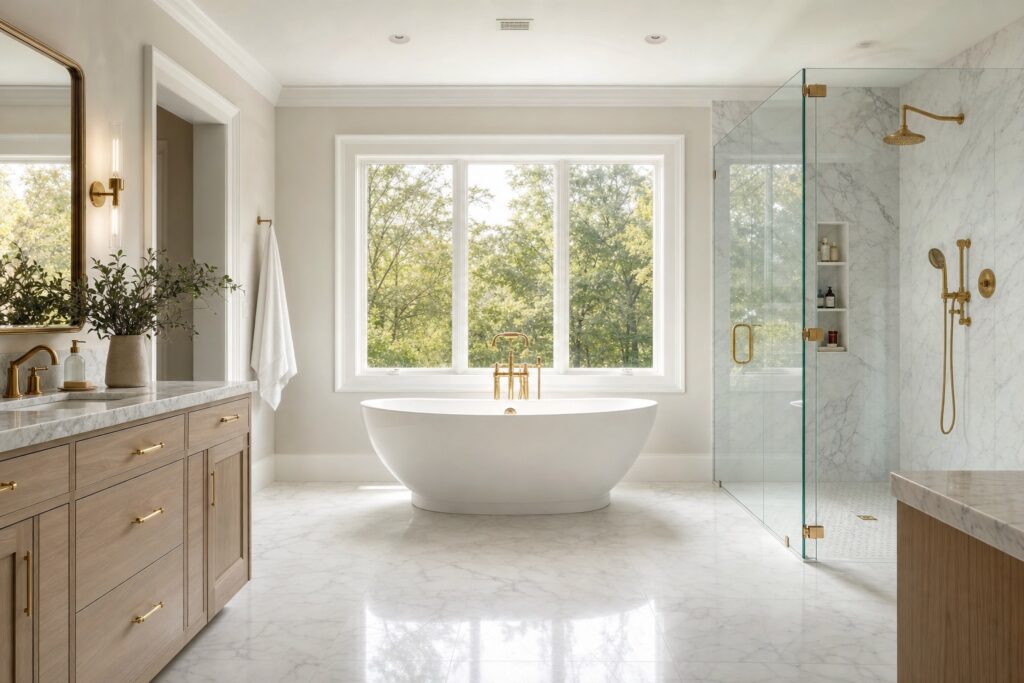
A primary bathroom remodel cost in Northern Virginia runs $45,000 to $85,000 in 2026, while a full luxury spa bath lands between $70,000 and $115,000 or more. These figures sit roughly 20 to 30 percent above national averages because labor, permitting, and material costs in Fairfax, Loudoun, Prince William, and Arlington counties are among the highest in the region. If you are weighing a curbless walk-in shower, a freestanding soaking tub, radiant heated floors, or a steam shower, the spend depends far less on square footage than on how much you change the plumbing, what tile and shower systems you choose, and the level of millwork and fixtures you specify. This guide breaks down real 2026 numbers, the design ideas worth the money, and how budgets actually shake out across Northern Virginia.
Table of Contents
Quick answer: primary bathroom remodel cost in Northern Virginia (2026)
In 2026, a primary bathroom remodel cost in Northern Virginia typically falls between $45,000 and $85,000 for a mid-to-upper-tier renovation, and a true spa bathroom climbs to $70,000 to $115,000 or more. The exact number is driven by tile and shower systems, plumbing relocation, vanity and millwork, fixtures, and waterproofing rather than the room’s footprint alone. Homeowners in McLean, Great Falls, and Vienna tend to land at the upper end because of larger footprints and premium finish expectations, while solid mid-range remodels in Prince William County communities like Gainesville and Bristow can come in lower. The table below gives a fast orientation before we dig into each cost driver in detail.
| Remodel tier | 2026 cost range (Northern Virginia) | What it typically includes |
|---|---|---|
| Refresh / mid-range | $45,000 – $60,000 | New tile, vanity, fixtures, lighting; same layout |
| Upper-tier primary | $60,000 – $85,000 | Curbless shower, double vanity, some plumbing moves, heated floors |
| Luxury spa bath | $70,000 – $115,000+ | Steam shower, freestanding tub, full layout change, smart controls |
| Estate / custom | $115,000+ | Custom millwork, structural changes, top-tier stone and fixtures |
What drives primary bathroom remodel cost in Northern Virginia
The single biggest misunderstanding about primary bathroom remodel cost is that bigger rooms automatically cost more. In reality, the budget is governed by the complexity of what is behind the walls and under the floor. A modest 90-square-foot primary bath with a relocated shower, a new freestanding tub drain, and a steam unit can cost more than a 150-square-foot bath that keeps every fixture in place. Below are the five drivers that move Northern Virginia budgets the most, and understanding them is the fastest way to control your spend without sacrificing the features that matter. We see these same patterns whether the project is in Oakton, Ashburn, or Alexandria, though local labor and permit costs nudge the totals up or down.
Tile and shower systems
Tile is usually the largest single line item in a Northern Virginia primary bath, often $12,000 to $30,000 installed once you account for material, waterproofing, and skilled labor. Large-format porcelain, natural stone, and intricate mosaic accents each carry different labor rates because they demand different setting techniques and substrate prep. A curbless walk-in shower with frameless glass requires precise floor sloping and a linear drain, which adds labor compared with a standard curbed shower. Heated shower benches, niches, and full-height tile walls all add square footage of installed tile, and in the McLean and Great Falls market, clients frequently specify book-matched slabs that push material costs well past $40 per square foot before installation.
Plumbing relocation
Moving plumbing is where budgets quietly balloon. Keeping the toilet, shower, and vanity drains in their existing locations can save $8,000 to $15,000 versus a full layout change. Relocating a drain means opening the floor, rerouting waste lines to maintain proper slope, and in many older Vienna and Arlington homes, working around joists or slab construction that complicates the run. Adding a freestanding tub almost always requires a new floor drain and supply lines, and a steam shower needs a dedicated generator location with its own plumbing and electrical. If your design keeps the wet wall intact, you protect a meaningful chunk of budget for finishes instead.
Vanity, millwork, and storage
Cabinetry has become a more volatile line in 2026 because of new cabinet tariffs that raised the cost of many imported lines. A stock double vanity might run $2,500 to $5,000, while custom millwork from a local shop, fitted to an exact wall and topped with quartz or natural stone, commonly reaches $9,000 to $18,000. Linen towers, makeup stations, and integrated medicine cabinets add both material and installation labor. In Loudoun County’s newer Ashburn and Leesburg homes, semi-custom cabinetry hits the sweet spot of quality and value, while estate remodels in Great Falls often justify full custom millwork because it defines the room’s character.
Fixtures and fittings
Faucets, showerheads, valves, the freestanding tub itself, and the toilet can quietly consume $6,000 to $20,000 depending on brand tier. A thermostatic shower system with multiple body sprays and a rain head costs several times what a single-function valve does, and digital or smart controls add both the device cost and additional electrical and low-voltage rough-in. Backlit mirrors, heated towel bars, and integrated bidet seats are increasingly standard in upper-tier Northern Virginia baths. Choosing one statement fixture and keeping the rest mid-tier is a reliable way to get a luxury feel without a luxury invoice across every line.
Waterproofing and substrate
Waterproofing is invisible and non-negotiable, and it is the line homeowners most often overlook when comparing bids. A properly built shower uses a bonded waterproofing membrane, correct slope, and quality substrate, typically adding $2,500 to $6,000 to the project. Skipping or cutting corners here is the leading cause of failed showers and expensive callbacks two to three years later. In radiant-heated-floor installations, the heating mat sits within a mortar bed that must be coordinated with the waterproofing and tile plan. A reputable Northern Virginia builder will line-item waterproofing clearly rather than burying it, and that transparency is a useful signal when comparing contractors.
Spa bathroom features worth the investment
A spa bathroom is defined less by a single luxury item than by how several systems work together to create a calm, hotel-grade experience. The features below are the ones Northern Virginia homeowners most often request in 2026, and each carries a different cost and return profile. The goal is not to include every feature but to choose the two or three that match how you actually use the space. A couple who showers daily and rarely baths should prioritize a generous curbless shower and steam over a sculptural tub, while a homeowner who decompresses in the evening may put the freestanding soaking tub at the center of the design and budget accordingly.
Curbless walk-in shower with frameless glass
The curbless walk-in shower is the anchor of nearly every modern Northern Virginia spa bath. Eliminating the curb creates a seamless, accessible floor plane and a more open visual line, while frameless glass keeps sightlines clean and makes the room feel larger. Expect this to add $4,000 to $10,000 over a standard curbed shower because of the precise floor sloping, linear drain, and reinforced waterproofing required. The accessibility benefit is real: a curbless entry supports aging in place, which matters in Fairfax County neighborhoods where homeowners plan to stay for decades. Frameless glass panels are custom-measured and tempered, so lead times should be built into your schedule.
Freestanding soaking tub
A freestanding soaking tub is the visual centerpiece many homeowners want, and it signals luxury instantly. Budget $1,800 to $9,000 for the tub itself, plus plumbing for a floor-mounted or wall-mounted filler and a new drain. The honest tradeoff is that freestanding tubs consume floor space and require a deck or floor filler that adds plumbing complexity. In larger McLean and Great Falls primary baths there is room to give the tub its own zone near a window, while in tighter Arlington and Alexandria footprints a built-in tub or a shower-only layout often makes better use of the space and budget.
Radiant heated floors
Radiant heated floors are one of the highest-satisfaction upgrades in a Northern Virginia spa bath, especially given cold winters. An electric radiant mat under tile typically adds $1,500 to $4,500 depending on square footage and whether a dedicated circuit and programmable thermostat are needed. The warmth underfoot transforms the daily experience, and because the system is embedded during the tile installation, it is far cheaper to include now than to retrofit later. Pairing heated floors with a heated towel bar completes the hotel feel. This is a feature clients rarely regret and frequently cite as their favorite element after the project is complete.
Steam shower and smart controls
A steam shower turns a daily routine into a wellness ritual, and it is increasingly requested in Loudoun and Fairfax county remodels. Adding steam typically costs $4,000 to $9,000 for the generator, sealed enclosure, vapor-proof ceiling slope, and controls. Smart and digital controls let you preset water temperature, steam duration, and lighting, and they add both device cost and low-voltage wiring. Backlit mirrors with integrated defoggers and adjustable color temperature round out the technology package. These systems should be specified early because they affect framing, electrical, and the shower enclosure design rather than being added at the end.
Primary bathroom remodel cost by Northern Virginia area
While the cost drivers are consistent across the region, local labor rates, permit fees, home values, and typical footprint sizes shift the final numbers meaningfully from one area to the next. Fairfax County permit fees rose 12.5 percent in 2026, and that increase, combined with cabinet tariffs, nudged budgets up across the board. The ranges below reflect what we see for comparable upper-tier primary and spa baths in each market, and they assume a quality build with proper waterproofing rather than a bargain renovation. Use them to set expectations, then refine with a detailed scope for your specific home.
McLean and Great Falls
McLean and Great Falls sit at the top of the Northern Virginia market, and primary bath budgets reflect it. Larger footprints, estate-level finish expectations, and frequent requests for custom millwork, book-matched stone, and full spa packages push typical projects into the $85,000 to $140,000 range, with luxury builds exceeding that. Homeowners here often combine a freestanding tub, a steam-equipped curbless shower, and radiant floors in a single design. Because many of these homes are larger and structurally more complex, plumbing relocation and structural coordination add to both cost and timeline. The return on a well-executed spa bath is strong in this market, where buyers expect high-end primary suites.
Vienna, Oakton, and Fairfax
Vienna, Oakton, and Fairfax represent the heart of the upper-mid market. Primary bath remodels here commonly land between $55,000 and $95,000 depending on whether the layout changes and the spa feature set. Many homes in these communities are 1980s to early-2000s construction with serviceable but dated baths, so clients frequently keep the wet wall to control cost while upgrading tile, vanities, fixtures, and adding heated floors. Fairfax County’s 12.5 percent permit fee increase applies here, so factor that into the budget. This market rewards a balanced approach: one or two standout spa features paired with durable, timeless finishes that appeal broadly at resale.
Arlington and Alexandria
Arlington and Alexandria primary baths often work within tighter, older footprints, including condos, townhomes, and early-twentieth-century houses. Budgets typically run $50,000 to $90,000, with the upper end driven by structural quirks, access challenges, and the premium on smart space planning. In these compact baths, a curbless shower with frameless glass and a well-designed double vanity often deliver more value than a large soaking tub. Older construction can surprise crews with outdated plumbing or unexpected framing, so a contingency is wise. The dense urban character of these markets also means parking, permitting, and HOA or condo board approvals can affect both cost and schedule.
Loudoun County (Ashburn, Leesburg)
Loudoun County, including Ashburn and Leesburg, blends newer construction with growing demand for spa-level primary suites. Typical remodels run $50,000 to $95,000, and because many homes are 2000s-and-later builds, layouts are often workable without major structural changes, which helps control cost. Semi-custom cabinetry and large-format porcelain are popular here for their balance of quality and value. Loudoun homeowners frequently prioritize radiant floors and curbless showers, and steam showers are a growing request. The market is competitive at resale, so a thoughtfully updated primary bath with durable finishes is a reliable value-add in these communities.
Prince William County (Gainesville, Haymarket, Bristow)
Prince William County communities such as Gainesville, Haymarket, and Bristow generally offer the most accessible entry point for a quality primary bath remodel in Northern Virginia, with typical projects from $45,000 to $80,000. Newer housing stock often means cooperative layouts and fewer structural surprises. Homeowners here get strong value by focusing budget on a curbless shower, heated floors, and a quality double vanity rather than maxing every line. As a Bristow-based design-build firm, we know this market intimately and can guide trade-offs that protect the experience while respecting the budget. Spa features remain very achievable here within a sensible total.
Sample primary and spa bathroom remodel budgets
Real budgets make the ranges concrete. Below are two representative Northern Virginia projects: a balanced upper-tier primary bath and a full luxury spa bath. These allocations show how the dollars distribute across the major categories and where the spa version adds cost. Your actual breakdown will shift with finish selections and how much plumbing you relocate, but these proportions are typical of what we build across Fairfax, Loudoun, and Prince William counties. Note how tile, plumbing, and cabinetry dominate both budgets, which is exactly why those are the levers to pull when you want to manage the total.
| Category | Upper-tier primary (~$72,000) | Luxury spa bath (~$104,000) |
|---|---|---|
| Demolition and prep | $3,500 | $5,000 |
| Plumbing (rough and finish) | $11,000 | $18,000 |
| Electrical and lighting | $5,000 | $8,500 |
| Tile and waterproofing | $18,000 | $28,000 |
| Vanity and millwork | $10,000 | $17,000 |
| Fixtures and fittings | $9,000 | $16,000 |
| Shower glass | $3,500 | $5,500 |
| Heated floors / steam | $3,000 | $6,500 |
| Permits and management | $9,000 | $13,000 |
How to control your primary bathroom remodel cost
Controlling cost is not about choosing the cheapest options; it is about spending where it shows and saving where it does not. The homeowners who get the best results in Northern Virginia make deliberate trade-offs early, before demolition, when changes are still inexpensive. Below are the most effective levers we use with clients to keep budgets disciplined without producing a bathroom that feels compromised. The recurring theme is that decisions made in the design phase determine 80 percent of the cost, so investing time in planning pays for itself many times over once the crews arrive.
Keep the plumbing where it is
If your existing layout is functional, keeping the toilet, shower, and vanity drains in place is the single most effective way to save money, often $8,000 to $15,000. You can dramatically change the look of a bath with new tile, fixtures, lighting, and cabinetry while leaving the wet wall untouched. Reserve plumbing relocation for cases where the current layout genuinely fights how you live in the space. When a freestanding tub or steam shower is a true priority, accept the plumbing cost for that feature specifically rather than reorganizing the entire room.
Spend on what you touch and see daily
Direct budget toward the elements you interact with every day: the shower system, the vanity surface, the faucet you turn, and the floor underfoot. These reward investment with daily satisfaction. Conversely, you can choose mid-tier options for items that are less tactile, such as the toilet or recessed lighting trims, without anyone noticing. A single luxury statement, like a beautiful stone slab on the shower wall or a sculptural tub filler, often delivers more perceived value than spreading the same dollars thinly across every category.
Lock the scope before demolition
Change orders are the most common reason projects exceed budget. Every decision deferred until after demolition costs more in both money and time. Finalize your tile, fixtures, cabinetry, and layout before the first wall comes down, and confirm long-lead items like frameless glass and custom vanities are ordered early. A detailed, fixed scope with allowances clearly defined protects you from surprise invoices and protects the schedule. The discipline of deciding everything up front feels demanding, but it is the difference between a project that finishes on budget and one that drifts.
Build in a realistic contingency
Older homes in Arlington, Alexandria, and parts of Vienna routinely hide surprises behind the walls: outdated wiring, failed prior waterproofing, or framing that does not match the plan. A contingency of 10 to 15 percent gives you room to address these without derailing the project or forcing you to cut finishes. If the contingency goes unused, it simply stays in your pocket. Treating it as a planned part of the budget rather than an afterthought keeps decision-making calm when the inevitable discovery happens mid-project.
Timeline for a primary and spa bathroom remodel
A realistic Northern Virginia primary bath remodel takes about four to eight weeks of active construction, with design and procurement adding several weeks before work begins. Spa baths with steam, custom glass, and relocated plumbing sit at the longer end. Understanding the sequence helps you plan and prevents the frustration of expecting a two-week turnaround on a complex build. The phases below are typical, and the procurement of long-lead items, especially custom glass and cabinetry, often determines the overall calendar more than the on-site labor itself.
Design and procurement
Before any demolition, expect two to six weeks for design finalization, selections, and ordering. Custom vanities, frameless glass, specialty tile, and steam equipment can carry lead times of several weeks each, and the project should not start until critical items are confirmed. This phase is where cost is controlled and where rushing causes the most expensive mistakes. A thorough design and selection process feels slow, but it is what allows the construction phase to proceed without stalls. Permitting in Fairfax and surrounding counties also begins here and should be factored into the calendar.
Demolition and rough-in
Demolition takes a few days, after which plumbing, electrical, and any framing changes are roughed in. This is when hidden conditions surface, so it is the phase where contingencies are most often used. Rough-in inspections by the county follow before walls are closed. In older homes, this stage can extend if outdated systems need updating to meet current code. Keeping this phase clean and correct is essential because everything visible later depends on the quality of work that gets covered up here.
Waterproofing, tile, and finishes
Waterproofing and tile typically take one to three weeks depending on complexity, and they cannot be rushed because membranes and mortar need proper cure times. Following tile, the crew installs the vanity, fixtures, glass, lighting, and final trim. Heated floors are set during the tile phase, and steam equipment is commissioned near the end. Final inspections and a punch-list walkthrough close the project. This finishing sequence is where the room finally becomes the space you envisioned, and careful coordination keeps the various trades from creating delays as they hand off to one another.
ROI and resale value of a primary bathroom remodel
A primary bathroom remodel is one of the more dependable home improvements for resale value, and in Northern Virginia’s strong housing market the returns hold up well. Mid-range bath remodels typically recover a substantial share of their cost at sale, and a well-designed primary suite is among the features buyers in McLean, Vienna, and Ashburn weigh most heavily. The key distinction is between timeless, broadly appealing finishes and highly personal choices. Below are the considerations that separate a remodel that adds market value from one that simply pleases the current owner, which is a perfectly valid goal in its own right.
Features buyers reward
Buyers consistently respond to curbless walk-in showers, double vanities, quality tile, heated floors, and abundant, well-organized storage. These read as upgrades across nearly every buyer profile. Neutral, durable materials photograph well and appeal broadly, which matters in a market where many sales begin online. A clean, contemporary primary bath signals that the home has been cared for and reduces buyer anxiety about deferred maintenance, which supports both price and speed of sale.
Personal luxury versus market return
Some spa features, like a steam shower or a sculptural freestanding tub, deliver tremendous personal enjoyment but a more modest direct resale premium. That is not a reason to skip them; it is a reason to be honest about why you are including them. If you plan to stay in your Great Falls or Gainesville home for many years, design for your own enjoyment. If a sale is near, weight the budget toward the broadly appealing upgrades that move the needle for buyers and keep highly personal choices restrained.
How Valor Builder approaches your primary and spa bathroom remodel
At Valor Builder, we approach every primary and spa bath as a design-build project, which means design, budgeting, and construction stay under one roof and one accountable team. That structure is exactly what prevents the change orders and miscommunication that inflate costs elsewhere. We start by understanding how you actually use the space, then build a detailed, transparent scope with clear allowances so you know where every dollar goes before demolition begins. Our primary and spa bathroom remodel services cover the full process from design through final walkthrough, and we self-perform and supervise the critical waterproofing and tile work that determines whether a shower lasts. We build throughout Fairfax County, Loudoun County, and Arlington, and as a Bristow-based firm we know the permitting, housing stock, and finish expectations of each Northern Virginia community. Our goal is a bathroom that performs beautifully for decades, delivered on a budget you understood from day one.
Frequently asked questions
How much does a primary bathroom remodel cost in Northern Virginia in 2026?
A primary bathroom remodel in Northern Virginia typically costs $45,000 to $85,000 in 2026, with luxury spa baths reaching $70,000 to $115,000 or more. These figures run about 20 to 30 percent above national averages due to higher local labor, material, and permitting costs. The exact number depends on tile, plumbing relocation, fixtures, and millwork rather than room size alone.
Why are bathroom remodels more expensive in Northern Virginia?
Northern Virginia costs run 20 to 30 percent above national averages because of high labor rates, elevated material prices, and rising permit fees. Fairfax County permit fees increased 12.5 percent in 2026, and new cabinet tariffs raised cabinetry costs across the region. Older homes in Arlington and Alexandria also add cost through structural surprises behind the walls.
What is the difference between a primary bath and a spa bathroom?
A primary bath is the main bathroom attached to the primary bedroom, while a spa bathroom adds wellness-focused features like a steam shower, freestanding soaking tub, radiant heated floors, and smart controls. The spa designation reflects the experience and feature set, not just the size. Spa baths typically cost $70,000 to $115,000 or more in Northern Virginia.
How long does a primary bathroom remodel take?
Active construction usually takes four to eight weeks, with spa baths at the longer end due to steam equipment, custom glass, and plumbing relocation. Add several weeks before construction for design, selections, and ordering long-lead items. Permitting in Fairfax and surrounding counties also factors into the overall timeline.
Is a curbless walk-in shower worth the extra cost?
For most homeowners, yes. A curbless shower adds $4,000 to $10,000 over a standard curbed shower but delivers a seamless, modern look and supports aging in place. It is one of the most broadly appealing upgrades at resale and a defining feature of a spa bath. The extra cost covers precise floor sloping, a linear drain, and reinforced waterproofing.
How can I reduce my primary bathroom remodel cost?
The most effective savings come from keeping the plumbing in its existing location, which can save $8,000 to $15,000. Lock your full scope before demolition to avoid costly change orders, and concentrate budget on the elements you touch daily. Choosing mid-tier options for less tactile items like the toilet preserves the luxury feel where it matters.
Do heated floors add much to the cost?
Electric radiant heated floors typically add $1,500 to $4,500 depending on square footage and whether a dedicated circuit is needed. Because the system installs during the tile phase, it is far cheaper to include now than to retrofit later. It is one of the highest-satisfaction upgrades in a Northern Virginia spa bath, especially in cold winters.
How much does a freestanding soaking tub cost installed?
The tub itself ranges from $1,800 to $9,000, plus plumbing for a new drain and a floor- or wall-mounted filler. Freestanding tubs require floor space and add plumbing complexity, so they suit larger baths in McLean and Great Falls better than tight Arlington footprints. If you rarely bathe, that budget may be better spent on a larger curbless shower.
What is the most expensive part of a bathroom remodel?
Tile and the shower system are usually the largest single line item, often $12,000 to $30,000 installed once waterproofing and skilled labor are included. Plumbing relocation and custom millwork are the next largest variable costs. These three categories drive most of the difference between a mid-range and a luxury bath.
Will a bathroom remodel increase my home’s value?
Yes, a primary bathroom remodel is one of the more dependable improvements for resale value, particularly in Northern Virginia’s strong market. Mid-range remodels recover a substantial share of their cost at sale, and broadly appealing features like curbless showers and double vanities resonate with buyers. Highly personal spa features add enjoyment but a more modest direct resale premium.
Do I need a permit for a bathroom remodel in Fairfax County?
Yes, any remodel involving plumbing, electrical, or structural changes requires a permit in Fairfax County, and fees rose 12.5 percent in 2026. A cosmetic refresh that changes only finishes may not, but most primary and spa baths involve work that does. A design-build firm handles permitting as part of the project so you do not have to navigate it alone.
How much does a steam shower cost to add?
Adding a steam shower typically costs $4,000 to $9,000 for the generator, a sealed and vapor-proof enclosure, a sloped ceiling, and controls. It must be planned early because it affects framing, electrical, and the shower design. Steam is increasingly requested in Loudoun and Fairfax county spa baths for its wellness benefits.
Should I choose custom or semi-custom cabinetry?
Semi-custom cabinetry offers the best balance of quality and value for most Northern Virginia baths and is popular in Loudoun County’s newer homes. Full custom millwork, common in Great Falls estate projects, fits exact walls and defines a room’s character but costs $9,000 to $18,000 or more. With 2026 cabinet tariffs raising prices, getting the cabinetry decision right early protects your budget.
Plan your primary and spa bathroom remodel with confidence
A primary or spa bathroom remodel is a significant investment, and the difference between a stressful project and a great one comes down to planning, transparency, and a team that knows the Northern Virginia market. If you are ready to turn your ideas into a clear scope and a budget you can trust, we are here to help. Schedule a consultation with Valor Builder and let’s design a primary suite that performs beautifully for decades, on a budget you understood from day one.