

Energy-Efficient & Net-Zero Custom Homes in Northern Virginia (2026 Guide)
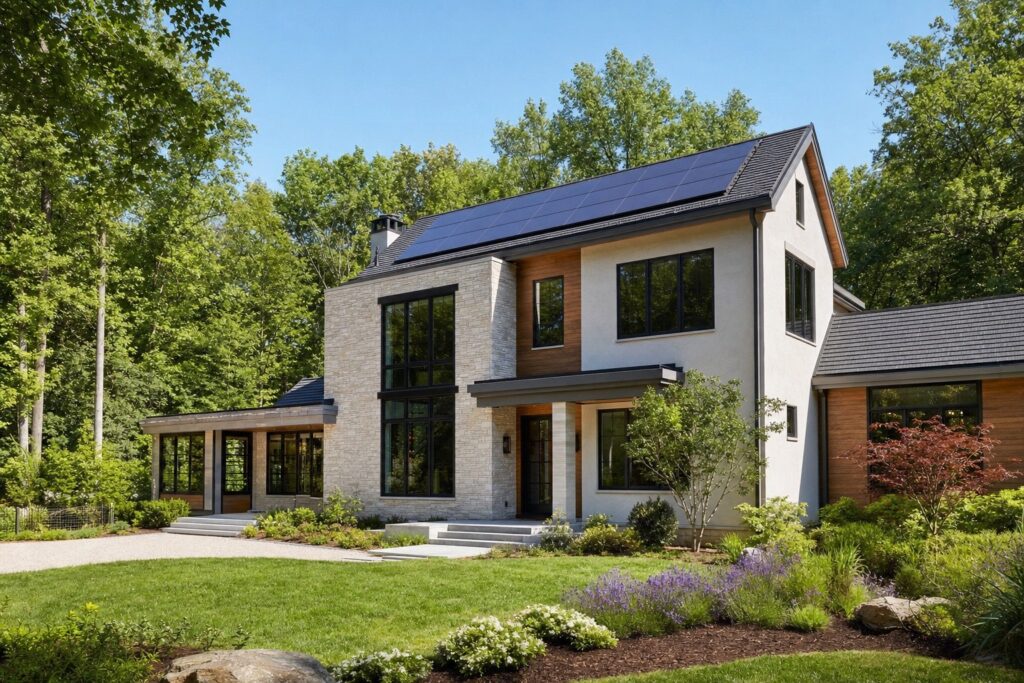
An energy-efficient home in Virginia is one engineered to use dramatically less energy than a standard build through a tight building envelope, advanced insulation, high-efficiency heat pumps, and smart controls, while a net-zero home goes further by producing as much energy as it consumes over a year, usually through rooftop solar. In Northern Virginia, building to high-performance or net-zero standards typically adds a 5-15% premium over a conventional custom home, but it sharply lowers monthly operating costs and can pay that premium back over the life of the house.
Table of Contents
Quick answer: what it costs to build an energy-efficient home in Virginia
A high-performance or net-zero custom home in Northern Virginia generally costs 5-15% more upfront than a comparable standard build, with most of that premium going into the envelope, mechanical systems, and solar. On a custom home priced at $1,000,000, that translates to roughly $50,000 to $150,000 in additional investment, offset by lower utility bills, federal tax credits, and stronger resale value. The exact figure depends on how far you push performance: a tightened ENERGY STAR-style build sits at the low end, while a certified Passive House or fully net-zero home with battery storage sits at the high end. The table below summarizes the major upgrades and what each typically adds to a custom home budget in Fairfax, Loudoun, Prince William, and Arlington counties.
| Upgrade | What it does | Typical added cost |
|---|---|---|
| High-performance envelope & insulation | Reduces heat loss/gain, improves comfort | $15,000 – $40,000 |
| Comprehensive air sealing | Cuts drafts and infiltration losses | $3,000 – $8,000 |
| Triple-pane windows | Lowers conduction and improves comfort near glass | $10,000 – $30,000 |
| High-efficiency heat pumps (HVAC + water) | Efficient all-electric heating, cooling, hot water | $8,000 – $25,000 |
| HRV/ERV ventilation | Fresh, filtered air in a tight house | $4,000 – $10,000 |
| ENERGY STAR appliances + induction cooking | Lower plug and cooking loads | $3,000 – $9,000 |
| Solar PV (6-12 kW) | On-site generation toward net-zero | $18,000 – $40,000 |
| Battery storage | Backup power and load shifting | $12,000 – $25,000 |
| Smart controls & monitoring | Optimizes use, surfaces waste | $2,000 – $6,000 |
What makes an energy efficient home in Virginia perform
An energy efficient home in Virginia is not a single product you buy; it is a system of decisions that reinforce one another. Northern Virginia sits in a mixed-humid climate with cold winters, hot and muggy summers, and long shoulder seasons, so a home here has to manage both heating and cooling loads as well as moisture. The most cost-effective performance comes from getting the envelope and air sealing right first, then sizing mechanical systems to the reduced load, and only then adding solar and storage. Builders who skip the envelope and bolt solar onto a leaky house spend more to generate energy the building immediately wastes. The sections below walk through the components in the order they matter, which is also roughly the order in which your dollars do the most work.
The building envelope and insulation
The envelope is the continuous barrier of walls, roof, and foundation that separates conditioned interior space from the outdoors, and it is the single biggest lever on a home’s energy use. In a high-performance Northern Virginia build, that means thicker wall assemblies, continuous exterior insulation to break thermal bridges, and well-insulated roofs and slabs. Upgrading from code-minimum to a robust envelope commonly adds $15,000 to $40,000 on a custom home, but it permanently lowers heating and cooling loads, allowing smaller and cheaper mechanical equipment. A strong envelope also delivers comfort you can feel: even interior temperatures, warmer floors in winter, and far less noise from the street. For homes in Great Falls or Haymarket on larger lots, the envelope is where comfort and quiet are won.
Air sealing and blower-door testing
Air sealing closes the countless small gaps where conditioned air leaks out and humid or cold air leaks in, around rim joists, top plates, penetrations, and window rough openings. A typical new home loses a surprising share of its energy to this uncontrolled infiltration, and tightening it is among the cheapest performance dollars you can spend, often $3,000 to $8,000. The work is verified with a blower-door test that pressurizes the house and measures the leakage rate, giving you a hard number rather than a promise. In a tight house, you control ventilation deliberately rather than relying on leaks, which improves both efficiency and indoor air quality. Air sealing pairs inseparably with mechanical ventilation, which is why the two are always specified together in a serious Northern Virginia build.
Triple-pane windows and doors
Windows are the weakest thermal point in most walls, and upgrading to triple-pane units with low-emissivity coatings and insulated frames sharply reduces conduction and radiant loss. In Northern Virginia’s climate, triple-pane glass keeps interior surfaces closer to room temperature, which eliminates the cold-glass draft feeling near large windows in winter and reduces condensation. Expect triple-pane to add roughly $10,000 to $30,000 over standard double-pane on a custom home, depending on the size and number of openings. The payback is partly energy and partly comfort and durability, since warmer interior glass resists condensation that can damage trim and sills. For homes with expansive glazing in McLean or Vienna, high-performance windows are essential to keeping those views from becoming a thermal liability.
High-efficiency heat pumps
Modern cold-climate heat pumps heat and cool a home using electricity far more efficiently than older systems or fossil-fuel furnaces, and they are the backbone of an all-electric high-performance home. A heat-pump water heater applies the same principle to domestic hot water, often using a third of the energy of a conventional electric tank. Together these systems commonly add $8,000 to $25,000 over standard equipment, but they cut operating costs and pair naturally with on-site solar. Because a tight, well-insulated home has a low heating and cooling load, the equipment can be smaller, which partially offsets the upgrade cost. Properly sized and commissioned heat pumps run quietly and maintain steady temperatures, an advantage homeowners in Arlington and Alexandria notice immediately through humid summers.
Ventilation, appliances, and induction cooking
Once a house is tight, it needs mechanical ventilation to stay healthy, and a heat- or energy-recovery ventilator (HRV/ERV) supplies fresh filtered air while reclaiming heat or humidity from the outgoing stream. This typically adds $4,000 to $10,000 and is non-negotiable in a high-performance home. ENERGY STAR appliances and induction cooktops further trim electrical loads while improving everyday performance; induction in particular is faster, more precise, and keeps combustion byproducts out of the home. These upgrades together usually add $3,000 to $9,000. None of them is dramatic on its own, but stacked on top of a strong envelope and efficient heat pumps, they push the home toward the low total energy demand that makes net-zero achievable with a reasonably sized solar array.
Solar, storage, and reaching net-zero in Northern Virginia
Net-zero is the point where a home’s annual on-site energy production equals its annual consumption, and in Northern Virginia that is reached by first driving demand down and then meeting the remainder with rooftop solar. Because efficiency is cheaper than generation, the smartest path is a tight, efficient house paired with a right-sized photovoltaic array rather than a leaky house buried under panels. Battery storage is optional for net-zero but valuable for resilience and for shifting solar energy into evening hours. The subsections below cover how these systems fit together and what to expect on cost and performance under our regional sun and utility rules.
Sizing a solar PV system
A typical high-performance Northern Virginia home reaches net-zero with a 6-12 kW solar array, costing roughly $18,000 to $40,000 before incentives, with the exact size driven by the home’s reduced energy demand and available roof area. South- and west-facing roof planes with minimal shading produce the most, so orientation and tree cover on wooded lots in Oakton or Great Falls matter. The lower your home’s consumption, the smaller and cheaper the array needed to offset it, which is why envelope and mechanical upgrades come first. A well-designed system is sized against a modeled annual energy budget rather than guesswork, so the array is neither undersized nor wastefully large. Good design here is what makes net-zero economical rather than aspirational.
Battery storage and resilience
Home battery storage stores solar energy for use after sunset or during outages, typically adding $12,000 to $25,000 depending on capacity. It is not required to achieve net-zero on an annual basis, since grid-tied homes export surplus daytime production and draw at night, but it adds meaningful resilience during the storms that periodically knock out power across Loudoun and Prince William counties. Batteries also let homeowners shift usage to avoid peak-rate periods where time-of-use pricing applies. For families who prioritize keeping critical loads running through an outage, storage is often worth the premium even before its energy-shifting benefits. We help clients weigh storage as a resilience investment separate from the pure net-zero math.
Smart controls and monitoring
Smart thermostats, load monitors, and integrated energy dashboards add roughly $2,000 to $6,000 and turn a high-performance home into one that actively manages itself. Real-time monitoring surfaces waste, confirms that solar production is meeting expectations, and lets homeowners fine-tune comfort against cost. Automated controls can pre-condition the house using solar energy, coordinate battery charging, and flag equipment problems before they become expensive. None of this replaces a good envelope, but it captures the last increment of savings and gives owners visibility into a system that would otherwise be invisible. In practice, the homes that perform best long-term are the ones whose owners can see and understand their own energy use.
Certifications: ENERGY STAR, LEED, and Passive House
Third-party certifications give a high-performance home an independently verified standard rather than a builder’s say-so, and they range from accessible to rigorous. Choosing among them is a question of how far you want to push performance and how much documentation and verification you are willing to fund. All three are well established in Northern Virginia, and each carries different cost and resale implications discussed below.
ENERGY STAR certified homes
ENERGY STAR is the most accessible certification, requiring a home to meet defined efficiency targets verified by a third-party rater, and it is a sensible baseline for any high-performance build. It typically adds modest cost over a standard build because much of what it requires, good insulation, sealed ducts, and efficient equipment, is already best practice. For many Northern Virginia families, an ENERGY STAR home delivers most of the comfort and operating-cost benefits without the expense of the most demanding standards. It is also widely recognized by buyers, so the label carries resale weight. We treat ENERGY STAR as a floor rather than a ceiling for energy-efficient custom homes.
LEED for Homes
LEED is a broader green-building certification that scores not only energy but water use, materials, indoor air quality, and site sustainability, awarding tiered levels from Certified up to Platinum. It suits homeowners who want a comprehensive sustainability credential beyond pure energy performance. LEED adds cost for documentation, modeling, and verification, and the premium scales with the level pursued. For a client building in McLean or Leesburg who values a recognized, holistic standard, LEED provides a structured framework and strong market signal. It pairs well with the energy upgrades already described, since those earn many of the energy-related points.
Passive House (PHIUS)
Passive House is the most demanding standard, setting strict limits on heating and cooling demand and airtightness that require a superinsulated envelope, meticulous air sealing, and careful detailing. It delivers the lowest operating costs and the most consistent comfort of any approach, but it carries the highest premium, often landing at the top of the 5-15% range or beyond. Passive House makes the most sense for owners committed to the deepest performance and willing to invest in the design rigor it demands. In our region’s mixed-humid climate, a certified Passive House stays comfortable with remarkably little energy, and it is the surest foundation for a true net-zero home.
Incentives, tax credits, and the real cost premium
The headline 5-15% premium overstates the true net cost, because federal tax credits, utility incentives, and lower operating expenses all work in the homeowner’s favor. Understanding the full financial picture, not just the sticker premium, is what separates a sound investment from sticker shock. The subsections below break down the incentives, the genuine premium after they are applied, and the payback math.
Federal tax credits and utility incentives
Federal tax credits for residential solar and certain efficient equipment can offset a meaningful share of those specific upgrade costs, directly reducing the net premium on solar and qualifying systems. Virginia and local utility programs periodically offer additional incentives and favorable interconnection and net-metering arrangements that improve solar economics. Because these programs change, we confirm current eligibility and amounts during design rather than relying on last year’s numbers. Stacked together, federal and utility incentives can turn a solar array’s gross cost into a substantially smaller net figure. The key is to plan systems so they qualify, which is a design decision made early, not an afterthought.
The true cost premium after incentives
After incentives, the effective premium on a high-performance Northern Virginia home commonly lands in the lower portion of the 5-15% range, with solar in particular far cheaper net of credits. On a $1,000,000 custom home, a gross premium of $80,000 to $120,000 can shrink meaningfully once solar credits and utility incentives are applied. The remaining premium buys permanently lower bills and a more comfortable, durable, quieter house. Framed this way, the decision is less about whether to spend more and more about how to allocate the upgrade budget for the best return. The table later in this guide shows how that allocation plays out on a representative build.
Payback and return on investment
Payback is the point at which accumulated energy savings and incentives equal the upfront premium, after which the home effectively generates positive cash flow against a standard build. For a well-designed Northern Virginia net-zero home, the efficiency upgrades and solar typically pay back over a span of years well within the home’s life, and often within the period of ownership. Beyond direct utility savings, a high-performance home carries lower volatility, since it is insulated from energy-price swings, and it tends to command a resale premium with increasingly energy-aware buyers. The comfort, air quality, and resilience benefits, while harder to put a number on, are real and immediate. We model expected payback for each client so the investment is grounded in their actual numbers.
Budget example for a net-zero custom home in Northern Virginia
To make the premium concrete, the table below shows a representative allocation of the upgrade budget on a high-performance, net-zero-ready custom home. The figures are illustrative and vary with home size, site, and finish level, but they show how the dollars distribute across the systems that matter. Note how the envelope, air sealing, and mechanicals, the unglamorous parts, account for a large share, with solar and storage layered on top to close the gap to net-zero.
| Category | Representative investment | Primary benefit |
|---|---|---|
| Envelope & insulation upgrade | $28,000 | Lower loads, comfort, durability |
| Air sealing & blower-door | $6,000 | Less infiltration, better air quality |
| Triple-pane windows | $22,000 | Comfort, reduced conduction |
| Heat pumps (HVAC + water) | $18,000 | Efficient all-electric operation |
| HRV/ERV ventilation | $7,000 | Fresh filtered air |
| ENERGY STAR appliances + induction | $6,000 | Lower plug and cooking loads |
| Solar PV (9 kW) | $30,000 | On-site generation toward net-zero |
| Battery storage | $18,000 | Resilience, load shifting |
| Smart controls & monitoring | $4,000 | Optimization, visibility |
| Total upgrade premium | $139,000 | Before federal/utility incentives |
How to control cost without sacrificing performance
The goal is not to buy every upgrade but to spend in the order that yields the most performance per dollar, which keeps a high-performance home within reach. Smart sequencing and early decisions are what hold the premium toward the low end of the range. The subsections below outline how we keep cost disciplined while protecting the result.
Prioritize the envelope first
Because envelope and air-sealing improvements reduce the load that every other system has to serve, they deliver compounding savings and should be funded before solar or storage. A tighter, better-insulated house needs smaller, cheaper mechanical equipment and a smaller solar array to reach net-zero, so early envelope spending pays for itself partly through downstream reductions. Cutting the envelope to afford more panels is the classic mistake, and it produces a less comfortable, more expensive-to-run home. We always settle envelope and air-sealing targets before sizing equipment. This discipline is the single most important cost-control decision in a high-performance build.
Right-size mechanical systems
Oversized heating and cooling equipment costs more to buy, runs inefficiently, and controls humidity poorly, so accurate load calculations on the improved envelope let us specify smaller, cheaper, better-performing systems. In a tight Northern Virginia home, the heating and cooling load is often far lower than rule-of-thumb sizing would suggest, and matching equipment to the real load avoids paying twice. This is where the envelope investment partially recoups itself. Proper sizing also improves comfort and equipment lifespan. It is a place where doing the engineering carefully saves money rather than adding it.
Phase solar and storage
Solar and battery systems can be designed in from day one but installed in phases, letting homeowners spread cost while keeping the option open to reach full net-zero later. A net-zero-ready home with conduit, electrical capacity, and roof orientation planned for solar can add panels and storage when budget or incentives align, without rework. This staging keeps the initial premium lower while protecting the long-term goal. We routinely design homes to be net-zero-ready even when the full array is deferred. It is a practical way to make the highest tier of performance reachable on a real budget.
Energy-efficient custom homes by Northern Virginia area
Performance priorities shift with lot, neighborhood, and housing stock across our service area, and tailoring the approach to each community produces a better result. The subsections below highlight what tends to matter most in each part of Northern Virginia we build in.
McLean and Great Falls
Larger lots and larger, glass-forward custom homes in McLean and Great Falls put the spotlight on the envelope and on high-performance triple-pane windows, since expansive glazing and big conditioned volumes can drive energy use up quickly. Wooded Great Falls lots also raise solar-siting questions where mature tree cover shades roof planes, making careful array placement and envelope-first design especially important. These are homes where comfort, quiet, and even temperatures across large open spaces are the headline benefits. We prioritize a superinsulated envelope and well-detailed glazing here. Solar is then sized against the modeled demand and the available unshaded roof.
Vienna, Oakton, and Fairfax
In Vienna, Oakton, and Fairfax, custom and infill builds on established lots benefit from a balanced, full-stack approach: a strong envelope, efficient heat pumps, and a right-sized solar array that fits the typical roof. These communities suit ENERGY STAR or higher certification well, delivering strong comfort and operating-cost gains without exotic measures. Lot orientation on infill parcels guides solar planning, and we design for net-zero-readiness even where the full array is phased. The result is a comfortable, durable home with low bills that fits naturally into the neighborhood. This is the heart of our energy-efficient custom home work in Fairfax County.
Arlington and Alexandria
Denser Arlington and Alexandria lots reward an envelope-and-mechanical focus, since roof area for solar can be more limited and humidity control through long summers is a priority. High-efficiency heat pumps and tight, well-ventilated envelopes keep these homes comfortable and quiet on compact urban sites. Where roof space allows, a modest solar array still moves the home toward net-zero, and battery storage adds welcome resilience. We emphasize air sealing and ventilation strongly here for both comfort and indoor air quality. The payoff is a refined, efficient home that performs through the region’s muggiest weather.
Loudoun County
Loudoun County communities such as Ashburn and Leesburg, with newer neighborhoods and generous lots, are well suited to the full high-performance package including ample solar and battery storage for resilience against storm outages. Roof orientation and lot size often allow arrays large enough to reach true net-zero comfortably. The county’s growth-oriented housing stock makes high-performance design an easy fit, and energy-aware buyers there increasingly value the certification and low bills. We frequently build net-zero-ready and net-zero homes across Loudoun County. Storage in particular earns its keep here given periodic weather-driven outages.
Prince William County
In Prince William County, including Gainesville, Haymarket, and our home base of Bristow, larger lots and a build-oriented market make the complete energy-efficient approach both practical and popular. Generous roof and site area support solar arrays sized for net-zero, and battery storage adds resilience valued in these communities. We bring our envelope-first discipline to every Prince William build, then layer mechanicals, solar, and storage to match the client’s goals and budget. The combination of space, value, and performance is compelling here. As a Bristow-based builder, this is the region we know best.
How Valor Builder approaches your energy-efficient and net-zero custom home
Valor Builder is a design-build custom home builder, and we treat energy performance as an engineering problem solved at the design table rather than a list of products added at the end. Our energy-efficient and net-zero custom home services start with modeling your home’s energy budget, settling envelope and air-sealing targets first, then right-sizing heat pumps, ventilation, solar, and storage against that budget. We build this way across Fairfax County, Loudoun County, and Arlington, tailoring the package to each lot, neighborhood, and family. Because we are honest about costs, we show you where every upgrade dollar goes and what it returns in comfort, bills, and resale, and we design net-zero-ready homes even when the full solar array is phased. The result is a home that is quieter, healthier, and far cheaper to operate, built to a verified standard you can stand behind for decades.
Frequently asked questions
What is a net-zero home?
A net-zero home produces as much energy over a year as it consumes, typically by combining a very efficient building with on-site solar. It still connects to the grid, drawing power at night and exporting surplus during the day, so that the annual balance nets to roughly zero. Reaching net-zero in Northern Virginia depends first on driving energy demand down through the envelope and mechanicals.
How much more does an energy-efficient home cost in Virginia?
A high-performance or net-zero custom home typically adds a 5-15% premium over a standard build, which on a $1,000,000 home is roughly $50,000 to $150,000. The premium depends on how far you push performance, from a tightened ENERGY STAR build at the low end to a certified Passive House at the high end. Federal and utility incentives reduce the true net cost, especially for solar.
What is the payback period on energy-efficient upgrades?
For a well-designed Northern Virginia net-zero home, efficiency upgrades and solar typically pay back over a span of years that falls within the home’s life and often within the period of ownership. The exact timeline depends on the upgrade mix, incentives captured, and energy prices. Beyond direct savings, the home gains resale value and insulation from energy-price swings.
Which upgrade gives the best return?
The building envelope and air sealing usually give the best return because they reduce the load every other system must serve, producing compounding savings. They also allow smaller, cheaper mechanical equipment and a smaller solar array. That is why we fund the envelope before solar or storage in every high-performance build.
Do I need solar to have an energy-efficient home?
No. A home can be highly energy-efficient through its envelope, air sealing, and efficient heat pumps without any solar at all. Solar is what takes an efficient home the rest of the way to net-zero by generating energy on site, but the efficiency itself comes from the building, not the panels.
What certifications should I consider?
ENERGY STAR is an accessible baseline, LEED adds a broader sustainability framework covering water and materials, and Passive House is the most demanding energy standard with the lowest operating costs. The right choice depends on how far you want to push performance and how much verification you want to fund. We treat ENERGY STAR as a floor and design upward from there.
Are triple-pane windows worth it in Northern Virginia?
In Northern Virginia’s mixed climate, triple-pane windows meaningfully improve comfort by keeping interior glass closer to room temperature, eliminating cold-glass drafts in winter and reducing condensation. They reduce conduction loss and pair well with a high-performance envelope. They add roughly $10,000 to $30,000 on a custom home, with payback split between energy savings and comfort.
What is a blower-door test?
A blower-door test pressurizes or depressurizes the house with a calibrated fan and measures how much air leaks through the envelope, giving a hard number for airtightness. It verifies that air sealing was done well rather than relying on a promise. High-performance and certified homes use it to confirm they meet their target leakage rate.
Do net-zero homes work during power outages?
A standard grid-tied solar home shuts off during an outage for safety unless it includes battery storage or a compatible system. Adding a home battery lets critical loads, and sometimes the whole house, keep running through outages. This is why we often recommend storage as a resilience investment in Loudoun and Prince William counties.
Is induction cooking required for an efficient home?
Induction is not strictly required, but it fits an all-electric high-performance home well by being efficient, fast, precise, and free of combustion byproducts indoors. It supports the move away from natural gas that net-zero homes generally make. It is a modest upgrade that improves both performance and everyday cooking.
How big a solar array do I need for net-zero?
A typical high-performance Northern Virginia home reaches net-zero with a 6-12 kW array, with the exact size set by the home’s reduced energy demand and available unshaded roof. The lower your home’s consumption, the smaller and cheaper the array needed. We size the array against a modeled annual energy budget rather than guesswork.
Can I build net-zero-ready and add solar later?
Yes. We routinely design homes to be net-zero-ready, with the electrical capacity, conduit, and roof orientation planned for solar, so panels and storage can be added later without rework. This keeps the initial premium lower while protecting the long-term goal. It is a practical way to make the highest performance tier reachable on a real budget.
Does an energy-efficient home increase resale value?
Energy-efficient and net-zero homes tend to command a resale premium with increasingly energy-aware buyers, alongside lower operating costs that show up in monthly bills. Recognized certifications such as ENERGY STAR, LEED, and Passive House strengthen that market signal. The comfort, air quality, and resilience benefits also make the home easier to sell.
Plan your energy-efficient and net-zero custom home with confidence
If you are weighing a high-performance or net-zero custom home anywhere across Fairfax, Loudoun, Prince William, or Arlington counties, the smartest first step is a conversation grounded in your lot, your goals, and your budget. Schedule a consultation with Valor Builder and we will model your home’s energy budget, show you exactly where each upgrade dollar goes, and design a comfortable, durable, low-cost-to-operate home you can stand behind for decades.