

How Much Does It Cost to Finish a Basement in Northern Virginia? (2026 Guide)
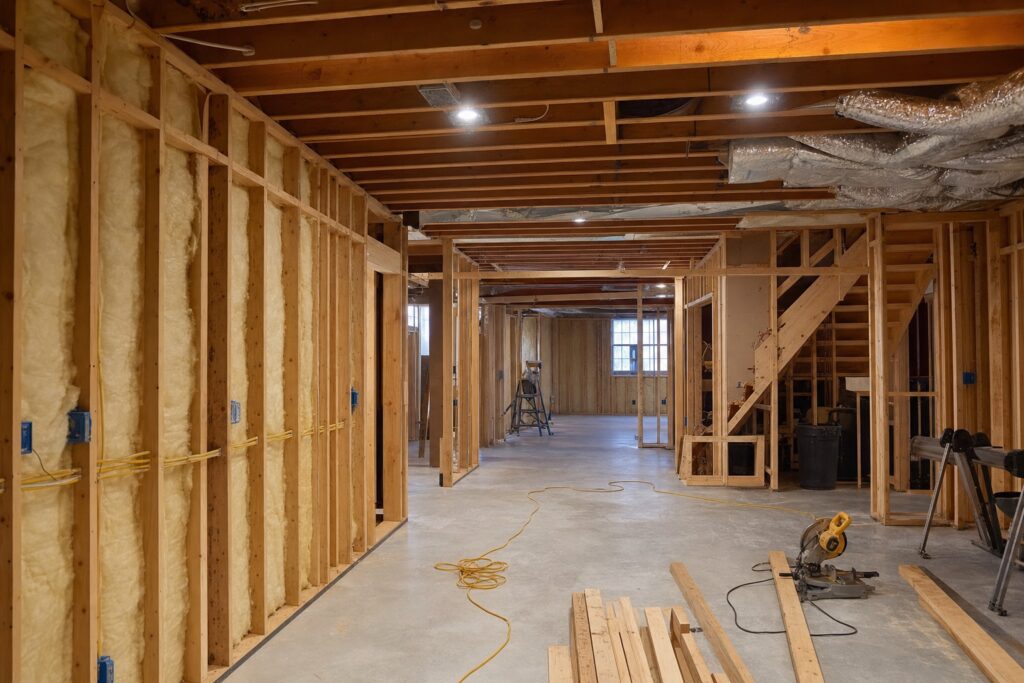
The cost to finish a basement in Northern Virginia in 2026 typically runs $50,000 to $150,000 for a roughly 1,000-square-foot space, which works out to about $100 to $150 per square foot. A simple rec room finish sits at the lower end, while a high-end basement with a home theater, wet bar, and full bath can reach $150,000 to $225,000. Where your project lands depends on ceiling height, moisture conditions, how many bathrooms and plumbing fixtures you add, whether you extend HVAC, and the level of finishes you choose. This 2026 guide breaks down every cost driver, gives realistic numbers by tier and by use, and explains how prices shift across McLean, Vienna, Arlington, Loudoun County, and Prince William County so you can budget your basement with confidence.
Table of Contents
Quick answer: basement finishing cost in Northern Virginia (2026)
The cost to finish a basement in Northern Virginia in 2026 is $50,000 to $150,000 for about 1,000 square feet, or roughly $100 to $150 per square foot. A converted in-law suite or accessory dwelling unit (ADU) generally runs $75,000 to $125,000, and a premium basement with a theater, wet bar, and full bathroom lands between $150,000 and $225,000. These figures reflect Northern Virginia’s labor and material market, which runs roughly 20 to 40 percent above the national average. Labor costs across the region rose another 4.5 to 6 percent heading into 2026, so quotes pulled from older online calculators will understate what local builders actually charge. Use the table below as your fast reference, then read on for the details that move your number up or down.
| Basement project type | Typical 2026 cost (Northern VA) | Approx. per sq ft |
|---|---|---|
| Basic rec/family room finish | $50,000 – $75,000 | $100 – $125 |
| Mid-range finish (bath + flex space) | $75,000 – $120,000 | $110 – $140 |
| In-law suite / ADU conversion | $75,000 – $125,000 | $120 – $150 |
| High-end (theater, wet bar, full bath) | $150,000 – $225,000 | $150 – $200+ |
| 2026 permit fees (1,000 sq ft) | $950 – $2,800 | – |
What actually drives basement finishing cost
Two basements of the exact same square footage can be priced $60,000 apart, and the difference almost always comes down to a handful of structural and systems decisions made before a single sheet of drywall goes up. Understanding these drivers is the single most useful thing you can do as a homeowner, because it lets you steer your budget intentionally rather than reacting to a surprise line item halfway through the project. Below are the eight factors that move basement finishing cost the most in Northern Virginia, roughly in the order they tend to matter. Read them as a checklist for your own space: the more of these that apply to your basement, the closer your project will sit to the upper end of the range.
Ceiling height and layout
Virginia code requires a minimum of 7 feet of clear ceiling height for habitable rooms, and many older Northern Virginia basements, especially in established neighborhoods of Vienna, Oakton, and Arlington, fall short once you account for ductwork, beams, and plumbing soffits. If your joists sit at 7 feet 2 inches and a main trunk line drops below that, you either reroute mechanicals or build the layout around the obstruction. Reframing soffits and relocating ducts can add $5,000 to $15,000, and underpinning to lower a floor is a major structural expense reserved for high-value homes. Open layouts with few interior walls finish faster and cheaper, while a chopped-up plan with several small rooms multiplies framing, drywall, doors, and electrical, pushing both labor hours and material counts higher.
Waterproofing and moisture control
Moisture is the factor homeowners underestimate most, and in Northern Virginia’s clay soils it is rarely optional. Before finishing, a quality builder evaluates grading, foundation cracks, hydrostatic pressure, and existing water staining. Depending on what they find, you may need interior or exterior drainage, a sump pump system, foundation crack injection, or a vapor barrier and dimple-board subfloor. Basic moisture management folds into most finishes, but a basement with a history of water intrusion can require $5,000 to $20,000 of remediation before any finishing begins. Skipping this step is the most expensive mistake you can make, because finishing over a damp foundation eventually means tearing out ruined drywall, flooring, and framing. In a region with humid summers and heavy spring rains, treating moisture as a foundation of the project, not an afterthought, protects every dollar that follows.
Adding a bathroom
A bathroom is usually the most valuable addition you can make to a finished basement and also one of the most expensive per square foot, because it concentrates plumbing, waterproofing, ventilation, and tile work into a small footprint. In Northern Virginia, a basement full bath typically adds $12,000 to $30,000 depending on whether you have existing rough-in plumbing. If the original builder stubbed in drains and a vent stack, you save thousands; if not, your contractor may need to break and trench the concrete slab to run new waste lines, which is labor-intensive and dusty. Below-grade fixtures sometimes require a sewage ejector pump because they sit lower than the main sewer line. A half bath costs less, but most homeowners adding guest or in-law space find a full bath worth the investment.
Wet bar or kitchenette
A wet bar or kitchenette transforms a basement from overflow space into a true entertaining or living suite, and the cost depends entirely on scope. A simple wet bar with a sink, mini-fridge, cabinetry, and a run of countertop typically adds $8,000 to $18,000. A full kitchenette with a range or cooktop, dishwasher, upper and lower cabinets, and stone counters, the kind of setup an in-law suite or ADU needs, runs $18,000 to $40,000 or more. The variables are plumbing distance, electrical capacity for appliances, ventilation if you cook, and the quality of cabinetry and surfaces you select. As with bathrooms, existing rough-in plumbing dramatically lowers the price. For homeowners in Great Falls and McLean building entertainment basements, the wet bar is often where premium finishes and custom millwork concentrate.
Egress windows and walkouts
Any basement bedroom in Virginia legally requires an emergency escape and rescue opening, which means an egress window or a walkout door. If your basement is fully below grade, creating an egress window involves excavating an areaway, cutting the foundation wall, installing a properly sized window, and building a code-compliant window well with a ladder or steps. This typically adds $3,500 to $8,000 per opening in Northern Virginia, more if the foundation is poured concrete rather than block. Walkout basements that already have an exterior door satisfy egress and also bring in natural light, which raises both livability and resale value. If you are planning a bedroom, in-law suite, or ADU, budget for egress early, because inspectors will not sign off on a sleeping room without it.
HVAC and electrical
A finished basement needs to be heated, cooled, and wired to code, and the existing systems in your home dictate how much that costs. Sometimes your current furnace and air handler have the capacity to extend a few supply and return runs into the new space, a relatively modest add. Other times the system is already at capacity, and you need a separate mini-split system, dedicated zone, or supplemental heating, which can add $4,000 to $12,000. Electrical work includes new circuits, recessed lighting, switches, outlets spaced to code, and often a subpanel if the main panel is full. Older Northern Virginia homes in Alexandria and Arlington frequently need a panel upgrade to support a finished basement’s load, particularly if you add a kitchenette, theater, or sauna. These systems are not glamorous, but they are non-negotiable and should be priced realistically.
Flooring and finishes
Finish level is the single biggest swing factor within any given basement footprint, and it is also where homeowners have the most control. Builder-grade carpet, basic LVP (luxury vinyl plank), flat-paint drywall, hollow-core doors, and recessed cans keep costs down. Engineered hardwood, large-format tile, custom trim and wainscoting, solid-core doors, designer lighting, built-in cabinetry, and stone surfaces push costs up quickly. In a below-grade space, moisture-tolerant flooring like LVP or tile is the smart default, since it tolerates humidity far better than solid wood. The same 1,000-square-foot basement can be finished for $55,000 with sensible mid-grade selections or $140,000 with premium materials and custom built-ins throughout. Deciding your finish tier early, and holding the line on it, is the most effective way to keep a basement project on budget.
Labor and the trades
Northern Virginia is a high-cost labor market, and skilled trades are in steady demand thanks to the region’s strong housing values and busy renovation economy. Electricians, plumbers, HVAC technicians, framers, drywall crews, tile setters, and finish carpenters all command premium rates here, and those rates rose another 4.5 to 6 percent into 2026. Labor typically accounts for 40 to 50 percent of a finished basement’s total cost. A complex basement with multiple wet rooms, intricate framing, and high-end finishes requires more specialized labor hours, which is why scope and labor scale together. Hiring a licensed, insured design-build firm that coordinates these trades under one roof usually costs more upfront than piecing together subcontractors, but it protects the schedule, the permit process, and the quality of the result.
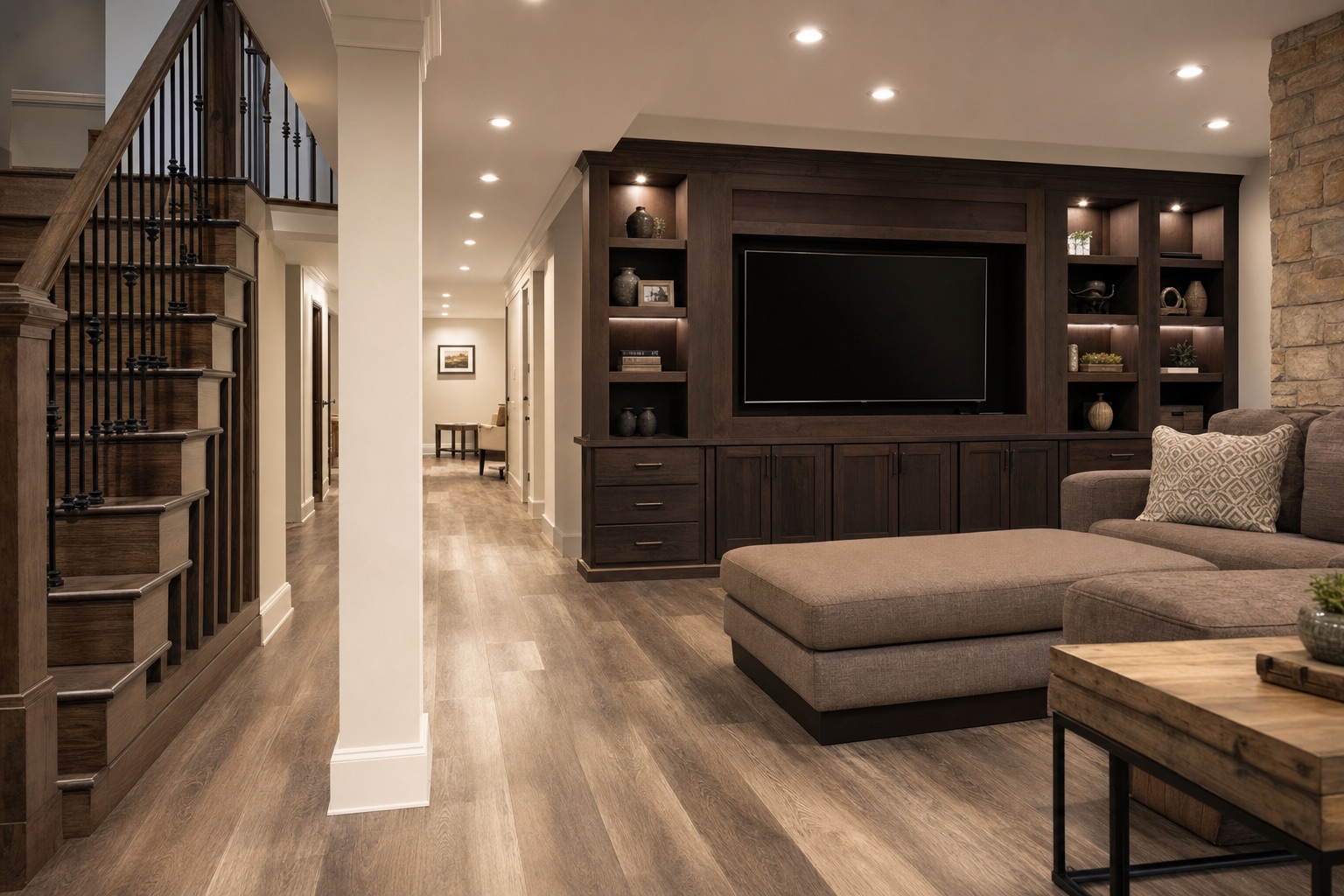
2026 basement finishing cost by tier
Most homeowners find it easiest to budget by tier, since each tier bundles a coherent set of finishes, systems, and uses. The tiers below assume a roughly 1,000-square-foot Northern Virginia basement with reasonable ceiling height and manageable moisture conditions. If your basement needs significant waterproofing, egress excavation, or an HVAC upgrade, add those costs on top of the tier figure, since they are largely independent of finish level. These numbers reflect 2026 regional pricing and a licensed design-build approach with permits pulled and inspections passed, not an unpermitted handyman finish. Use the tier that matches your goals as a planning anchor, then refine it with a contractor walkthrough that accounts for your specific foundation, mechanicals, and design wishes.
| Tier | What’s included | 2026 cost (1,000 sq ft) |
|---|---|---|
| Essential | Open rec room, LVP flooring, recessed lighting, basic trim, no bath | $50,000 – $70,000 |
| Standard | Rec room, full bath, one enclosed room, mid-grade finishes | $75,000 – $110,000 |
| Premium | Multiple rooms, full bath, wet bar, upgraded finishes, custom lighting | $110,000 – $150,000 |
| Luxury | Home theater, full wet bar/kitchenette, full bath, custom millwork, wine room | $150,000 – $225,000+ |
Basement finishing cost by use: what each space adds
Beyond overall tier, the specific rooms you build determine where your money concentrates. A basement is rarely a single use; most Northern Virginia homeowners blend a few of the spaces below into one cohesive plan. Pricing each use as a module helps you prioritize when the wish list outruns the budget. The figures here represent the incremental cost of adding that use to a basement that is already being framed and drywalled, so they assume shared overhead like permits, moisture control, and base HVAC are already accounted for elsewhere in the project. Mix and match to estimate your own program.
Rec room or family room
The rec room is the backbone of nearly every finished basement and the most economical square footage you will create. An open family room with LVP or carpet, recessed lighting, painted drywall, and a few outlets and data drops is the baseline finish, often landing between $45 and $75 per square foot for that portion of the space. Because it requires no plumbing and minimal framing, the rec room dilutes your overall per-square-foot cost, which is why basements with large open areas tend to price lower per foot than those chopped into many small rooms. Many homeowners in Ashburn, Bristow, and Gainesville start here and leave the option open to add a bar or bathroom later as budget allows.
Home theater
A dedicated home theater is a premium feature that layers specialized work onto the base finish: tiered or stepped flooring for seating, sound isolation and acoustic treatment, blackout design, dedicated electrical circuits, structured wiring for projector and surround sound, and sometimes a starlight ceiling or cove lighting. A modest media room with a large TV and surround speakers might add $10,000 to $25,000, while a true dedicated theater with a projector, riser, acoustic panels, and integrated AV can add $30,000 to $70,000 or more. The equipment itself is a separate budget from the construction. Theaters are a signature request in higher-value homes around McLean, Great Falls, and Vienna, where homeowners build basements specifically for entertaining.
Full bathroom
Adding a full bath is the highest-impact upgrade for both daily livability and resale, and it typically adds $12,000 to $30,000 in Northern Virginia. The spread depends almost entirely on plumbing: a basement with existing rough-in is far cheaper than one requiring slab cutting for new drain and supply lines, and below-grade fixtures may need a sewage ejector pump. Tile selection, shower glass, vanity quality, and fixtures account for the rest of the range. A full bath is essential if you plan a guest room, in-law suite, or ADU, and it meaningfully increases the appraised value of the finished space, which makes it one of the easiest line items to justify even on a tight budget.
In-law suite or ADU
Converting a basement into an in-law suite or accessory dwelling unit typically costs $75,000 to $125,000 in Northern Virginia, because it bundles the most expensive features into one project: a bedroom with code-compliant egress, a full bathroom, a kitchenette or full kitchen, separate HVAC or zoning, sound insulation, and often a private entrance through a walkout. Multigenerational living has surged across Fairfax and Loudoun counties, and a well-designed basement suite can house aging parents, adult children, or a rental tenant. Local zoning and ADU rules vary by jurisdiction and govern separate entrances, kitchens, and rental use, so confirm requirements early. Done correctly, a basement suite is among the highest-return basement investments because it effectively adds a livable dwelling to your home.
Basement finishing cost by Northern Virginia area
Pricing is not uniform across Northern Virginia. Material costs are fairly consistent regionally, but labor rates, permit fees, home values, and the finish expectations of each market shift the typical project total. Higher-value areas tend to see larger, more elaborate basements simply because homeowners scope bigger projects, not because the same exact work costs dramatically more. The area notes below describe the typical range and character of basement projects we see in each part of the region, so you can calibrate your expectations to your own neighborhood. Wherever you are, the underlying cost drivers, moisture, plumbing, egress, ceiling height, and finish level, remain the same; only the scale and finish ambition tend to change.
McLean and Great Falls
McLean and Great Falls sit at the top of the regional market, and basement projects here skew toward the premium and luxury tiers. Homeowners frequently commission full entertainment basements with home theaters, full wet bars or catering kitchens, wine rooms, guest suites, and spa-style baths, with budgets commonly running $150,000 to $250,000 or more. Larger lot homes often have walkout basements with abundant natural light, which simplifies egress and elevates livability. Finish expectations are high: custom millwork, stone surfaces, integrated smart-home AV, and designer lighting are the norm rather than upgrades. If you own in these communities, plan for a design-build process that emphasizes craftsmanship and detailing, because the resale market here rewards quality and penalizes shortcuts.
Vienna, Oakton, and Fairfax
Vienna, Oakton, and the broader Fairfax area form the heart of the regional basement market, with a wide mix of project types. Many homes here date to the 1960s through 1990s and have full basements with serviceable ceiling height, making them strong candidates for finishing. Typical projects land in the standard to premium range, $80,000 to $150,000, often combining a rec room, full bath, an office or two, and sometimes a wet bar or guest suite. Some older Vienna and Oakton homes need ceiling-height attention or moisture work, so a thorough pre-construction evaluation matters. This is also a hotbed for in-law suites, as multigenerational households are common across Fairfax County.
Arlington and Alexandria
Arlington and Alexandria present a distinct challenge: many homes are older, with smaller footprints, lower basement ceilings, and aging electrical and plumbing. Finishing a basement here often involves a panel upgrade, careful work around tight mechanical layouts, and creative design to maximize modest square footage. Row houses and historic homes may also carry additional permitting considerations. Projects commonly run $60,000 to $130,000, with the value of the finished space high relative to the limited square footage these neighborhoods offer. Because every foot counts, homeowners in Arlington and Alexandria benefit most from smart space planning, light-toned finishes, and built-ins that make compact basements feel open and intentional rather than cramped.
Loudoun County
Loudoun County, including Ashburn and Leesburg, is dominated by newer construction, which is good news for basement budgets. Homes built in the last 25 years frequently have generous ceiling heights, rough-in plumbing already stubbed for a future bath, and modern electrical panels with capacity to spare. That means many Loudoun basements skip the most expensive surprises and finish cleanly in the $70,000 to $140,000 range. Walkout and daylight basements are common on the area’s rolling lots, simplifying egress and bringing in light. Demand here trends toward family-friendly programs: large rec rooms, full baths, guest suites, home theaters, gyms, and playrooms. The combination of finish-ready bones and family-oriented buyers makes basement finishing especially rewarding in Loudoun.
Prince William County
Prince William County, including Gainesville, Haymarket, and Bristow, where Valor Builder is based, offers some of the best value in the region. The housing stock skews newer, so basements typically come with good ceiling height, rough-in plumbing, and capable mechanical systems, keeping projects efficient. Typical finishes land in the $60,000 to $130,000 range, covering rec rooms, full baths, in-law suites, offices, and entertainment spaces. Walkout basements are common on the area’s varied terrain. For homeowners here, the path to a great finished basement is usually shorter and less surprise-prone than in older inner-suburb neighborhoods, because the foundations and systems are already close to finish-ready. That efficiency lets more of the budget go toward finishes and livable features.
Where your basement budget goes
It helps to see how a typical basement budget breaks down by category, because it clarifies where cuts actually save money and where they only create risk. The percentages below reflect a standard, well-built Northern Virginia basement with a bathroom and mid-to-upper finishes. Your mix will shift with scope: a basement with two bathrooms and a kitchenette will weight more toward plumbing and cabinetry, while an open rec room will weight toward framing, drywall, and flooring. Notice how much of the budget lives in systems and labor that the eye never sees; this is precisely why bargain bids that skimp on mechanicals, waterproofing, and permits end up costing more in the long run.
| Budget category | Share of total |
|---|---|
| Framing, drywall, insulation | 15% – 20% |
| Plumbing (bath, bar, ejector) | 10% – 18% |
| Electrical and lighting | 10% – 15% |
| HVAC extension or system | 6% – 12% |
| Flooring | 8% – 12% |
| Trim, doors, paint, finishes | 10% – 15% |
| Cabinetry, bar, built-ins | 8% – 15% |
| Permits, design, project management | 8% – 12% |
| Waterproofing, egress, contingency | 6% – 12% |
A representative basement budget example
To make these numbers concrete, here is a realistic line-item budget for a roughly 1,000-square-foot Northern Virginia basement finished to a standard-to-premium level, the kind of project a family in Fairfax, Loudoun, or Prince William County commonly undertakes. This example includes an open rec room, one enclosed office or guest room with egress, a full bathroom, a wet bar, extended HVAC, and mid-to-upper finishes throughout, with permits pulled and inspections passed. The total lands near $110,000, squarely in the heart of the regional range. Your own quote will vary with foundation conditions and finish selections, but this gives you a credible framework for what each component contributes to the whole.
| Line item | Cost |
|---|---|
| Design, engineering, and permits | $9,500 |
| Moisture control and vapor barrier | $4,500 |
| Framing, insulation, and drywall | $19,000 |
| Egress window and well | $6,000 |
| Electrical, recessed lighting, subpanel | $13,500 |
| HVAC extension and zoning | $8,500 |
| Full bathroom (with rough-in) | $18,000 |
| Wet bar with cabinetry | $11,500 |
| Flooring (LVP and tile) | $9,000 |
| Trim, doors, and paint | $7,500 |
| Contingency (approx. 3%) | $3,000 |
| Total | $110,000 |
How to control basement finishing cost without cheapening it
The goal of a smart budget is not to spend as little as possible; it is to spend deliberately, putting money where it lasts and pulling back where it does not show. The strategies below let Northern Virginia homeowners trim a basement budget meaningfully while preserving the quality, durability, and resale value that make the project worthwhile. The common thread is that you save on layout, sequencing, and selective finishes, never on the foundation systems, moisture protection, mechanicals, or permits that keep the space sound for decades. A good design-build partner will help you apply these levers in the right order.
- Favor an open layout with fewer interior walls and doors to cut framing, drywall, and electrical costs.
- Keep wet rooms, bath, bar, and any kitchenette, clustered near existing plumbing stacks to minimize slab cutting.
- Choose moisture-tolerant mid-grade flooring like quality LVP instead of solid hardwood.
- Reserve premium finishes for high-impact focal points, the bar and bath, and keep the rec room clean and simple.
- Rough in plumbing and wiring now for a future bath or bar, then finish later when budget allows.
- Select stock cabinetry and standard fixtures over fully custom where the difference is mostly cosmetic.
- Never cut moisture control, egress, HVAC sizing, or permits; deferred problems here cost multiples to fix.
- Bundle the whole project with one design-build firm to avoid the cost overruns of disconnected subcontractors.
The hidden costs homeowners most often forget
The most painful basement surprises are almost never the finishes; they are the conditions hiding behind the walls and beneath the slab. Experienced Northern Virginia builders evaluate these before quoting, but homeowners planning their own budgets routinely leave them out, then feel blindsided when the estimate comes in higher than an online calculator suggested. Moisture and water issues top the list: a basement with poor grading, foundation cracks, or a high water table may need $5,000 to $20,000 of drainage, sealing, or sump work before finishing can responsibly begin. Code upgrades are next, an undersized electrical panel, outdated wiring, or insufficient HVAC capacity can each add thousands. Low ceilings may force ductwork rerouting or soffit redesign. Sump pumps and backup batteries protect your investment in a region prone to heavy rain. And radon mitigation, common in Northern Virginia’s geology, often runs $1,500 to $3,500 and is worth doing whenever you create a habitable below-grade space. Building these into your budget from day one keeps your project honest and prevents mid-stream sticker shock.
How long finishing a basement takes in Northern Virginia
A typical Northern Virginia basement finish takes 8 to 16 weeks from permit approval to final inspection, though scope, jurisdiction, and unforeseen conditions all influence the timeline. Permitting itself can add several weeks before construction starts, and complex projects with multiple wet rooms, custom millwork, or structural work run longer. The phased schedule below reflects a standard mid-range basement; an essential rec-room finish compresses, while a luxury basement with a theater and kitchenette extends. Material lead times for cabinetry, specialty tile, and AV equipment can also stretch the calendar, which is why early selections matter. Planning around this timeline helps you coordinate around holidays, family events, and any temporary disruption to the rest of your home.
| Phase | Typical duration |
|---|---|
| Design, selections, and permitting | 3 – 6 weeks |
| Rough-in (framing, plumbing, electrical, HVAC) | 2 – 4 weeks |
| Inspections and insulation/drywall | 2 – 3 weeks |
| Finishes (flooring, trim, paint, tile) | 2 – 4 weeks |
| Cabinetry, fixtures, and final details | 1 – 3 weeks |
| Final inspection and walkthrough | 1 week |
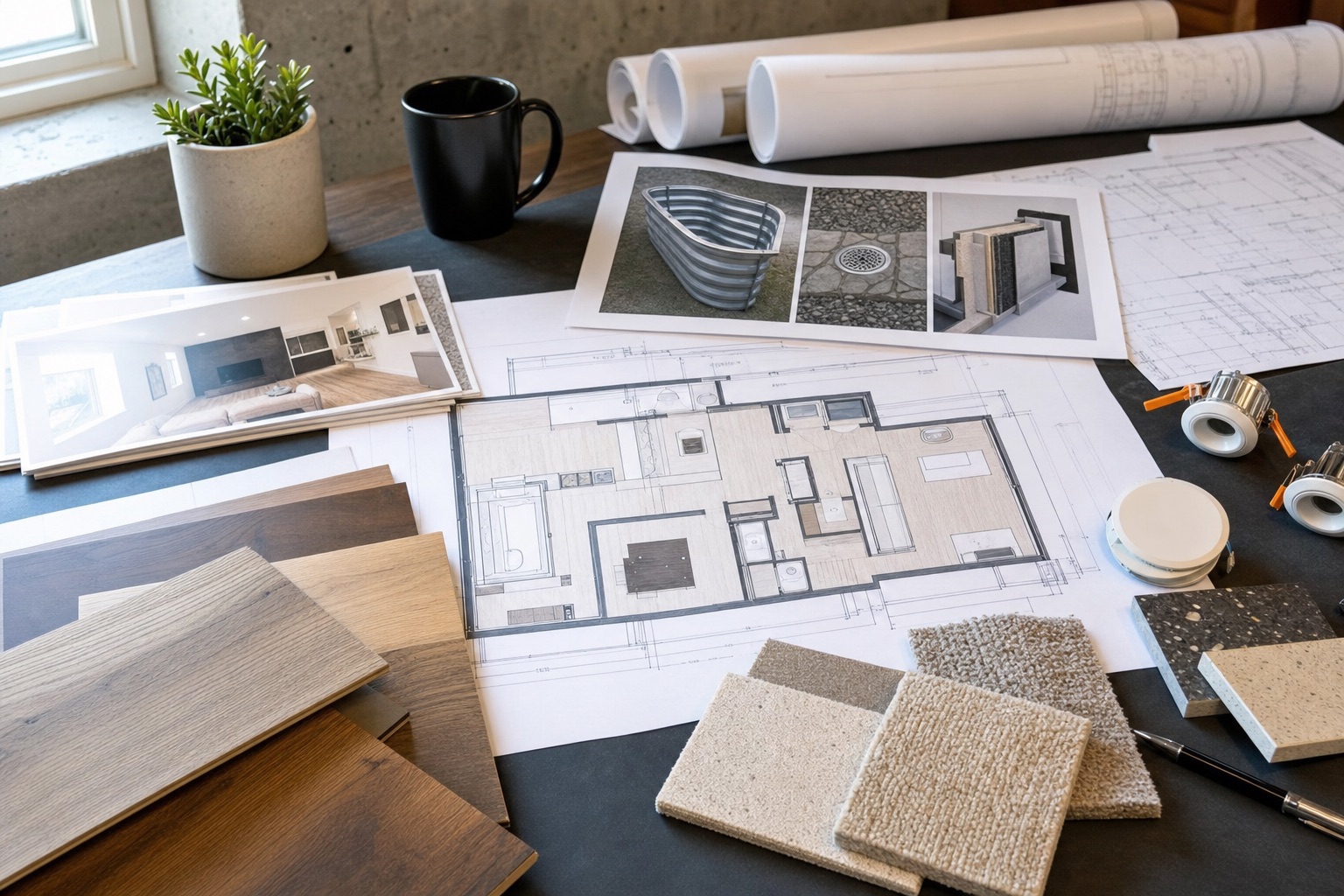
Permits, egress, and the process in Northern Virginia
Finishing a basement in Northern Virginia legally requires permits, and each jurisdiction, Fairfax County, Loudoun County, Prince William County, Arlington, and the City of Alexandria, runs its own building department with its own fees and review timelines. For a standard 1,000-square-foot basement, 2026 permit fees run roughly $950 to $2,800, covering building, electrical, plumbing, and mechanical permits along with required inspections. The process begins with a code-compliant plan set, then permit issuance, followed by staged inspections: a framing and rough-in inspection before walls are closed, and a final inspection before the space is occupied. Two code requirements catch homeowners off guard most often. First, every habitable room needs at least 7 feet of clear ceiling height. Second, any room used for sleeping must have an egress window or walkout door sized for emergency escape. Working with a licensed builder who handles permitting and knows each county’s requirements prevents failed inspections, stop-work orders, and the resale headache of unpermitted finished space, which appraisers and buyers’ inspectors will flag.
Common basement finishing mistakes to avoid
Most basement regrets trace back to a small number of avoidable mistakes, and nearly all of them involve rushing past the unglamorous fundamentals to get to the fun finishes. The list below reflects the issues that most often turn a basement project into a callback, a teardown, or a resale problem. Avoiding them does not require a bigger budget, just discipline and the right professional guidance early in the process.
- Finishing over unaddressed moisture, the single costliest error, leading to mold, ruined materials, and full re-dos.
- Skipping permits to save time or money, which creates failed resale appraisals and forced reopening of finished walls.
- Ignoring egress on bedrooms, which fails inspection and endangers occupants.
- Undersizing HVAC or electrical, leaving the space uncomfortable, code-deficient, or overloaded.
- Choosing solid hardwood or moisture-sensitive materials below grade instead of LVP or tile.
- Over-partitioning into many small rooms, raising cost and making the space feel cramped.
- Forgetting sound insulation and lighting design, which separate a polished basement from a cave.
- Hiring the cheapest bid without verifying licensing, insurance, and a clear, code-compliant scope.
How Valor Builder approaches your basement
At Valor Builder, we treat your basement as a design-build project from the first walkthrough, not a commodity finish, because the difference between a basement that lasts decades and one that fails in a few years lives in the parts you cannot see. Based in Bristow and serving all of Northern Virginia, we begin by evaluating the conditions that drive cost and risk, moisture, grading, ceiling height, mechanical capacity, and egress, before we ever talk finishes. From there we develop a transparent, line-item budget and a design that fits how your family actually lives, whether that is an entertainment basement in Fairfax County, a multigenerational suite in Loudoun County, or a compact, light-filled remodel in Arlington. We handle permits and inspections in every local jurisdiction, coordinate all trades under one roof, and hold the line on the moisture control, code compliance, and craftsmanship that protect your investment. Explore our basement remodeling services to see how we turn below-grade square footage into the most-used space in the home.
Frequently asked questions
How much does it cost to finish a basement in Northern Virginia in 2026?
Most basement finishing projects in Northern Virginia cost $50,000 to $150,000 for about 1,000 square feet, roughly $100 to $150 per square foot. High-end basements with a theater, wet bar, and full bath run $150,000 to $225,000. The exact figure depends on moisture conditions, plumbing, egress, HVAC, and finish level.
How much does it cost to add a bathroom to a basement?
A basement full bathroom typically adds $12,000 to $30,000 in Northern Virginia. The biggest variable is plumbing: existing rough-in keeps costs low, while cutting the concrete slab for new drain lines and adding a sewage ejector pump raises them. Tile, fixtures, and shower glass account for the rest of the range.
How much does a basement in-law suite or ADU cost?
A basement converted into an in-law suite or accessory dwelling unit typically costs $75,000 to $125,000 in Northern Virginia. That bundles a bedroom with egress, a full bath, a kitchenette, and often separate HVAC and a private entrance. Local zoning rules govern separate entrances, kitchens, and rental use, so confirm requirements with your jurisdiction early.
Do I need a permit to finish my basement in Northern Virginia?
Yes. Finishing a basement requires building, electrical, plumbing, and mechanical permits in every Northern Virginia jurisdiction. For a standard 1,000-square-foot basement, 2026 permit fees run roughly $950 to $2,800. Unpermitted work fails resale appraisals, can trigger stop-work orders, and must often be reopened for inspection, so always permit the project.
Does a basement bedroom need an egress window?
Yes. Any room used for sleeping must have an emergency escape and rescue opening, either an egress window with a code-compliant well or a walkout door. Adding an egress window to a below-grade basement typically costs $3,500 to $8,000 per opening in Northern Virginia. Inspectors will not approve a bedroom without it.
How long does it take to finish a basement?
A typical Northern Virginia basement finish takes 8 to 16 weeks from permit approval to final inspection. Permitting adds several weeks before construction begins, and complex projects with multiple wet rooms, custom millwork, or structural work run longer. Material lead times for cabinetry, tile, and AV equipment can also extend the schedule.
Is finishing a basement worth it for resale value?
Yes, especially in Northern Virginia’s high-demand market where buyers expect move-in-ready square footage. The strongest returns come from a full bathroom, a permitted guest or in-law suite, and a flexible rec room. Highly personalized features like theaters return less of their cost, so build those for your own enjoyment rather than resale.
What is the most expensive part of finishing a basement?
Wet rooms drive cost most: bathrooms, wet bars, and kitchenettes concentrate plumbing, waterproofing, and finishes into small footprints. Hidden conditions like moisture remediation, egress excavation, HVAC upgrades, and electrical panel work can also add thousands. Labor, which accounts for 40 to 50 percent of the total, is the largest single category.
Plan your basement project with confidence
A finished basement is one of the smartest ways to add livable, lasting space to a Northern Virginia home, but the difference between a project that delights for decades and one that disappoints comes down to honest budgeting, sound moisture and code work, and craftsmanship you can trust. If you are ready to put real numbers to your space and explore what is possible in your home, the team at Valor Builder is here to help you plan it right from the first walkthrough. Schedule a consultation with Valor Builder to get a transparent, line-item estimate and a design tailored to how your family lives, wherever you are across Fairfax, Loudoun, Prince William, and Arlington.