

Basement Apartments & ADUs in Northern Virginia: Cost & Rules (2026)
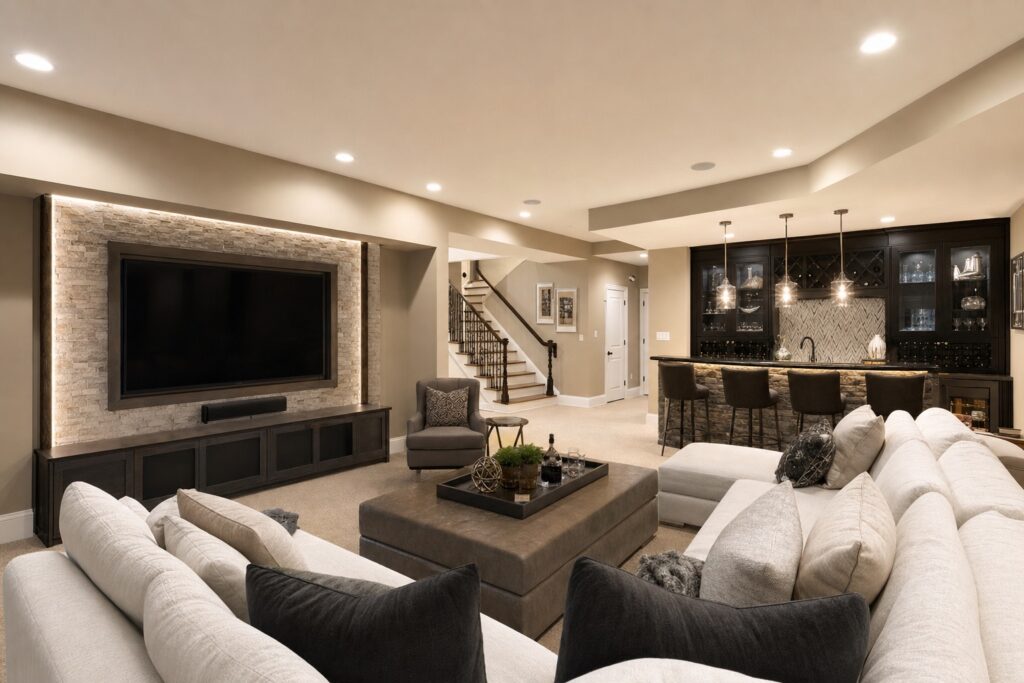
A basement apartment or ADU in Northern Virginia costs $75,000 to $125,000 for a full, code-compliant conversion in 2026. That price buys a finished space with a bedroom and egress window, a full bath, a kitchen or kitchenette, a separate entrance, separate or zoned HVAC, and proper sound insulation. The biggest swing factors are whether your basement already has rough plumbing, how much egress and waterproofing work it needs, and whether you are building a true rentable accessory dwelling unit (ADU) or a simpler in-law suite. This guide walks through real basement apartment cost virginia numbers, the new statewide ADU law arriving in 2027, the building-code requirements, and the rental ROI you can realistically expect across Fairfax, Loudoun, Prince William, and Arlington.
Table of Contents
Quick answer: basement apartment cost virginia in 2026
The basement apartment cost virginia homeowners should budget in 2026 is $75,000 to $125,000 for a complete conversion that includes a legal bedroom, a full bathroom, a kitchen or kitchenette, a separate exterior entrance, dedicated or zoned heating and cooling, and sound insulation between floors. A lighter in-law suite without a full kitchen or separate entrance can land closer to $45,000 to $70,000, while a high-end ADU with premium finishes, structural egress work, and a full kitchen can exceed $130,000. Permit fees in Northern Virginia run $950 to $2,800 depending on the jurisdiction and the scope of mechanical, electrical, and plumbing work. The table below summarizes the typical tiers so you can place your own project quickly.
| Project type | Typical cost (2026) | What you get |
|---|---|---|
| Basic in-law suite | $45,000 – $70,000 | Bedroom, full bath, sitting area; shared entrance, no kitchen |
| Standard basement apartment / ADU | $75,000 – $105,000 | Bedroom with egress, full bath, kitchenette, separate entrance, zoned HVAC |
| Full premium ADU | $105,000 – $130,000+ | Full kitchen, high-end finishes, structural egress, sound isolation, laundry |
| Permit fees | $950 – $2,800 | Building, electrical, plumbing, mechanical permits combined |
What drives basement apartment cost in Virginia
No two basements convert at the same price, and the spread between a $75,000 project and a $125,000 project usually comes down to five or six measurable factors. Understanding these drivers before you call a contractor lets you read estimates critically and spot where a low bid is quietly leaving out required work. In Northern Virginia, where homes range from 1960s ranches in Vienna to new-construction Toll Brothers basements in Ashburn, the starting condition of the space matters as much as the finishes you choose. Below are the cost drivers that move the needle most, ranked roughly by how much variance they introduce into a typical basement apartment cost virginia estimate.
Egress and the separate entrance
Every sleeping room in a basement apartment must have an emergency escape and rescue opening, which usually means cutting an egress window and excavating a window well. If your foundation needs a new opening saw-cut into poured concrete or block, expect $4,500 to $9,000 for the window, well, and waterproofing. A separate walk-out or walk-up entrance is the other big variable; a basement that already has a walkout door costs far less than one needing exterior stairs excavated and a new doorway cut. Together, egress and entrance work can account for $8,000 to $25,000 of a project, and they are non-negotiable for a legal, rentable unit.
Plumbing and the kitchen or kitchenette
Whether your basement was roughed in for a future bathroom is one of the largest single cost forks. If rough plumbing already exists, a full bath finishes for $9,000 to $16,000; if you must break the slab and trench new drain lines, add $4,000 to $9,000. A kitchenette with a sink, under-counter fridge, and microwave is far cheaper than a full kitchen with a range, because adding a gas line or a 240-volt circuit and a vented range hood raises both labor and inspection scope. Kitchenettes typically run $8,000 to $18,000 installed, while full kitchens push $18,000 to $35,000 depending on cabinetry and appliances.
HVAC, electrical, and sound insulation
A rentable unit needs comfortable, independently controllable heating and cooling. The cheapest compliant route is extending and zoning the existing system with a dedicated thermostat; a cleaner solution for true ADUs is a ductless mini-split, which runs $4,500 to $9,000 installed and gives the tenant full control. Electrical work, including a subpanel, dedicated circuits, and code-required smoke and carbon-monoxide detectors, typically adds $3,500 to $8,000. Sound insulation between the basement ceiling and the main floor, using resilient channel and mineral wool, runs $2,500 to $6,000 and is one of the most worthwhile upgrades for landlord-occupied homes where privacy matters to both parties.
Waterproofing, finishes, and ceiling height
Northern Virginia clay soils and older foundations make moisture control essential before you finish anything. Interior drainage, a sump pump, and vapor barriers can add $5,000 to $15,000 if the basement has a history of seepage. Finishes, flooring, trim, lighting, and paint then range from builder-grade to designer, swinging the total by $10,000 or more. Ceiling height is a hidden gatekeeper: Virginia requires a minimum 7-foot finished ceiling in habitable basement rooms, so a basement with 7-foot-2 joists may need careful planning around ductwork and beams to stay legal once the floor and ceiling are finished.
The new Virginia ADU law and 2026-2027 rules
The single biggest regulatory change for Northern Virginia homeowners is the new statewide ADU law, which takes effect January 1, 2027. The law legalizes accessory dwelling units across Virginia and overrides the restrictive local zoning that has historically made basement apartments difficult to permit in Fairfax, Arlington, and Loudoun. Until then, you are governed by current local zoning, so timing matters: a project you start in late 2026 may benefit from grandfathered review, while one permitted in 2027 will fall under the new statewide framework. The rules below combine the incoming state law with the building-code requirements that apply regardless of zoning.
What the 2027 state law changes
Beginning January 1, 2027, Virginia localities can no longer use zoning to flatly prohibit a single accessory dwelling unit on a lot with a single-family home. This is a meaningful shift in Fairfax, Arlington, and Loudoun, where conditional-use permits and special exceptions previously created long, uncertain approval paths. The law does, however, preserve some local authority: jurisdictions may still impose reasonable standards on size, parking, and design, and critically, they may require owner-occupancy, meaning the property owner must live in either the main house or the ADU. Setbacks, lot coverage, and health-department septic rules also remain in force, so the law removes the outright ban without removing all conditions.
Building-code requirements that always apply
Zoning decides whether you may build an ADU; the Virginia Uniform Statewide Building Code decides how. Two requirements trip up the most basements. First, habitable rooms need a minimum 7-foot finished ceiling height, measured after flooring and ceiling are installed. Second, every sleeping room below grade must have a compliant egress window with a minimum clear opening and a window well sized for escape, plus a permanently attached ladder if the well is deep. Beyond those, you need interconnected smoke and carbon-monoxide alarms, GFCI protection, proper stair rise and run, and a minimum of one full bathroom. These code rules apply whether you call the space an in-law suite or a rentable ADU.
Owner-occupancy and rental registration
Even after 2027, the most common condition Northern Virginia localities are expected to keep is owner-occupancy. If your county requires it, you cannot turn both the main house and the basement into separate rentals; you must occupy one of them. Several jurisdictions also require rental registration, a business license, or an accessory-dwelling permit before you can legally collect rent, and short-term rental use is regulated separately and often more strictly. Verify these requirements before you bank on rental income, because an unpermitted basement apartment can trigger fines, forced vacancy, and problems at resale when a buyer’s inspector flags non-permitted living space.
| Requirement | Standard (2026-2027) | Applies to |
|---|---|---|
| Minimum ceiling height | 7 feet finished | All habitable basement rooms |
| Egress window | Required in every sleeping room | In-law suites and ADUs |
| Smoke / CO alarms | Interconnected, hardwired | All conversions |
| Owner-occupancy | May be required by locality | Rentable ADUs |
| Permit fees | $950 – $2,800 | All permitted work |
| ADU zoning legalization | Statewide from Jan 1, 2027 | Single-family lots |
In-law suite vs. rentable ADU: which do you need
People use the words interchangeably, but a basement in-law suite and a rentable ADU are different products with different costs and rules. Choosing the right one early prevents expensive rework, because retrofitting a suite into a legal rental after the fact often means adding egress, a separate entrance, and a kitchen you skipped to save money. The distinction comes down to independence: an ADU is a fully self-contained second home with its own entrance, kitchen, and address potential, while an in-law suite is an extension of the main household that happens to be private. Below is how to tell which fits your goals and your property.
The basement in-law suite
An in-law suite is designed for family, an aging parent, an adult child, or a long-term guest, and it shares the home as a single dwelling. It typically includes a bedroom, a full bath, and a comfortable sitting area, often with a kitchenette but rarely a full kitchen, and it may share the main entrance rather than have a separate one. Because it is not a separate rental, it usually faces lighter zoning scrutiny, though it must still meet building-code egress and ceiling requirements. This is the right choice for multigenerational households who value proximity and shared utilities and who are not trying to generate rental income or create a legally distinct unit.
The rentable accessory dwelling unit
A rentable ADU is a self-contained home: a private entrance, a full or substantial kitchen, a full bath, sleeping space with egress, and independently controllable HVAC. It is what you build if you intend to lease the space to a non-family tenant for monthly income. An ADU carries more cost because of the separate entrance, the full kitchen, dedicated utilities or sub-metering, and the permitting and registration steps. After the 2027 state law, ADUs become far easier to legalize in Fairfax, Arlington, and Loudoun, but they remain subject to owner-occupancy and any local size and parking standards.
How the choice affects your budget
The decision can move your total by $30,000 or more. An in-law suite that shares an entrance and uses a kitchenette can finish in the $45,000 to $70,000 range, while a fully separate rentable ADU with its own entrance and full kitchen sits in the $90,000 to $125,000 range. If there is any chance you will rent the space later, it is almost always cheaper to build the separate entrance and rough in a full kitchen now rather than excavate and re-permit later. Think about a five-to-ten-year horizon, because a suite built today for a parent may become a rental once circumstances change.
Rental income and ROI on a Northern Virginia basement apartment
For many homeowners, the basement apartment math is really a rental-income calculation, and Northern Virginia is one of the strongest markets in the country for it. A legal one-bedroom basement apartment in Fairfax, Arlington, or Loudoun commonly rents for $1,500 to $2,400 a month in 2026, depending on finishes, location, and whether utilities are included. Against a $90,000 to $110,000 build cost, that rent often returns the investment in roughly four to six years, after which the unit becomes durable monthly cash flow plus added resale value. The sections below break down the income, the payback, and the value beyond rent.
Typical rents and gross yield
Rents vary sharply by location and quality. A finished one-bedroom basement ADU near Metro in Arlington or Alexandria can command $2,000 to $2,400, while a comparable unit in Gainesville or Bristow may rent for $1,400 to $1,800. On a $100,000 build renting at $1,900 a month, gross annual income is about $22,800, a gross yield near 22 percent before expenses. After accounting for vacancy, the share of utilities you cover, maintenance, and any rental registration costs, a realistic net yield often lands in the 12 to 16 percent range, which still strongly outperforms most passive investments available to a homeowner.
Payback period and break-even
The table below models payback at three common rent levels against a representative $100,000 build. Even at conservative rents, most Northern Virginia basement apartments break even within five to seven years, and the higher-rent scenarios near Metro break even in under five. After break-even, the rent is largely profit aside from maintenance, and the improvement continues to add resale value, which is why a well-built ADU is one of the highest-return renovations available to a Northern Virginia homeowner.
| Monthly rent | Annual gross | Years to recover $100,000 |
|---|---|---|
| $1,500 | $18,000 | ~6.5 years |
| $1,900 | $22,800 | ~5 years |
| $2,300 | $27,600 | ~4 years |
Resale value beyond the rent
Even if you never rent it, a legal, permitted basement apartment adds real resale value in Northern Virginia, where multigenerational living and income potential are in high demand. Appraisers will not always count below-grade space as gross living area, but a finished, permitted basement with a legal bedroom and full bath consistently lifts a home’s appeal and sale price. Just as important, the work must be permitted: unpermitted living space can become a liability at sale when buyers’ agents and inspectors flag it, sometimes forcing price concessions or last-minute legalization. Building it right the first time protects both your rental income and your eventual resale.
Basement apartment costs by Northern Virginia area
Labor rates, lot characteristics, and local zoning all vary across the region, so the same basement apartment costs a bit differently in McLean than in Bristow. The building code is statewide and uniform, but permit processing times, inspection scheduling, and the prevalence of walk-out basements differ by jurisdiction. Below is how basement apartment and ADU projects typically play out across the Northern Virginia communities Valor Builder serves, with notes on what tends to drive cost and feasibility in each.
McLean and Great Falls
McLean and Great Falls homes tend to be larger, on bigger lots, with high-end finish expectations, so basement apartment projects here usually land at the upper end, $100,000 to $130,000 or more. Many of these homes sit on septic systems, which means health-department capacity rules can limit whether a second dwelling is feasible without a system upgrade. The upside is space: walk-out basements and generous ceiling heights are common, simplifying egress and entrance work. Owners in these areas typically build premium in-law suites or high-finish ADUs for multigenerational living rather than purely for rental yield.
Vienna, Oakton, and Fairfax
Vienna, Oakton, and the broader Fairfax area offer some of the strongest rental demand in the region, driving steady interest in legal basement ADUs. Housing stock ranges from 1960s ranches with shallow ceilings to newer colonials roughed in for basement baths, so feasibility and cost vary widely. Expect $80,000 to $115,000 for a standard rentable unit. Fairfax County’s permitting is thorough, and the 2027 state law will notably ease the path for ADUs that previously needed special approval. Proximity to the Orange and Silver Line Metro supports rents at the higher end of the regional range.
Arlington and Alexandria
Arlington and Alexandria have the highest rents and the strongest case for a rentable ADU, with one-bedroom basement units often leasing for $2,000 to $2,400 near Metro. Lots are smaller and many homes are older, so egress and waterproofing can add cost, putting typical projects at $85,000 to $120,000. Both jurisdictions have been more progressive on ADUs than their suburban neighbors, and the 2027 law further strengthens that. Owner-occupancy and rental registration are likely conditions, so confirm local requirements early, but the payback period here is among the fastest in Virginia.
Loudoun County
Loudoun County, including Ashburn and Leesburg, has a large stock of newer homes with tall, dry basements often pre-plumbed for a future bath, which can meaningfully reduce conversion cost. Typical projects run $75,000 to $110,000, with the lower end achievable when rough plumbing and a walk-out already exist. Septic systems are common in the more rural western parts of the county and can constrain second-dwelling feasibility. Strong household incomes and steady rental demand around the data-center corridor and Silver Line extension make Loudoun ADUs an increasingly popular income strategy.
Prince William County
Prince William County, including Gainesville, Haymarket, and Bristow, where Valor Builder is based, offers the most favorable build economics in the region. Newer construction with dry, tall basements keeps costs in the $70,000 to $105,000 range, and many homes already have walk-out access or rough plumbing. Rents are lower than inside the Beltway, typically $1,400 to $1,900, but so are build costs, keeping the ROI competitive. The area’s growing population and proximity to commuter routes support steady demand for affordable, legal basement rentals.
How to control cost and what to watch for
The gap between a smooth basement apartment project and a budget-busting one usually comes down to decisions made before demolition starts. A few deliberate choices on layout, scope, and sequencing can save tens of thousands of dollars without compromising the legality or quality of the finished unit. At the same time, several common pitfalls quietly inflate cost or, worse, leave you with an unpermitted space that cannot be rented. The guidance below covers both sides: where to save and where cutting corners will cost you later.
Smart ways to control cost
The cheapest dollar is the one you do not spend moving water and waste. Keep the new bathroom and kitchen near existing plumbing stacks to avoid breaking the slab, and choose a kitchenette over a full kitchen unless you specifically need a range for a rental. Use a ductless mini-split instead of re-engineering the whole HVAC system, and pick durable mid-grade finishes that photograph well for tenants without designer pricing. Building the separate entrance and roughing in the kitchen during the initial project, even if you start as an in-law suite, avoids far costlier retrofits later. Bundling permits and inspections also reduces re-mobilization costs.
What to watch for
The biggest risk is skipping permits to save time and money. An unpermitted basement apartment cannot be legally rented, may be uninsurable after a claim, and becomes a liability at resale. Watch for low bids that omit egress, waterproofing, or a code-compliant ceiling height, because those omissions are not optional. Confirm septic capacity before assuming you can add a dwelling, verify owner-occupancy and rental-registration rules in your jurisdiction, and never trust a contractor who says inspections are unnecessary. Moisture is the other silent budget-killer: address drainage and waterproofing before finishing, or you will tear out new walls within a few years.
Realistic timelines
A straightforward basement apartment conversion in Northern Virginia typically takes 10 to 16 weeks of construction once permits are issued, but the permitting itself can add four to ten weeks depending on the jurisdiction and whether egress requires structural review. Projects involving slab work, septic evaluation, or zoning special exceptions can stretch the front end considerably. Building in time for design, permitting, and inspections, and sequencing waterproofing before finishes, keeps the schedule realistic. Plan for roughly four to six months from first consultation to a finished, inspected, rent-ready unit, and longer if your project relies on the 2027 state-law framework.
How Valor Builder approaches your basement apartment / ADU
Valor Builder is a design-build custom home builder and remodeler in Bristow that handles basement apartments and ADUs as complete, permitted projects from first sketch to final inspection. Our basement apartment / ADU services cover design, structural egress, waterproofing, plumbing, electrical, HVAC, and finishes under one accountable contract, so you are never coordinating separate trades or chasing inspections yourself. We build across the region, including Fairfax County, Loudoun County, and Arlington, and we know the local permitting, septic, and zoning landscape in each. We start by confirming feasibility, ceiling height, egress, and septic capacity, then give you an honest, line-item budget so there are no surprises mid-project. Whether you want a multigenerational in-law suite or an income-generating rental ADU positioned for the 2027 state law, we build it legally, comfortably, and to last.
Frequently asked questions
How much does a basement apartment cost in Virginia in 2026?
A full, code-compliant basement apartment or ADU in Northern Virginia costs $75,000 to $125,000 in 2026. That includes a bedroom with egress, a full bath, a kitchen or kitchenette, a separate entrance, zoned or separate HVAC, and sound insulation. A simpler in-law suite without a full kitchen or separate entrance can run $45,000 to $70,000.
Are basement apartments legal in Northern Virginia?
Yes, when they are permitted and meet the building code and local zoning. Today, zoning in Fairfax, Arlington, and Loudoun can make ADUs difficult, but the new Virginia ADU law takes effect January 1, 2027 and legalizes accessory dwelling units statewide, overriding restrictive local zoning. Localities may still require owner-occupancy and reasonable design standards.
What is the new Virginia ADU law?
Effective January 1, 2027, Virginia law legalizes accessory dwelling units across the state and prevents localities from using zoning to flatly prohibit a single ADU on a single-family lot. It overrides restrictive zoning in Fairfax, Arlington, and Loudoun. Localities may still impose size, parking, and design standards and may require the owner to occupy the home or the ADU.
What is the minimum ceiling height for a basement apartment?
The Virginia Uniform Statewide Building Code requires a minimum 7-foot finished ceiling height in habitable basement rooms. That measurement is taken after the floor and ceiling are finished, so a basement with low joists or ductwork may need careful planning to stay compliant. Spaces below 7 feet cannot be counted as legal habitable rooms.
Do I need an egress window in a basement bedroom?
Yes. Every sleeping room below grade must have a compliant emergency escape and rescue opening, typically an egress window with a properly sized window well. Cutting an egress window into a concrete or block foundation, with the well and waterproofing, usually costs $4,500 to $9,000. It is a non-negotiable code requirement for any legal bedroom.
What is the difference between an in-law suite and an ADU?
An in-law suite is part of the main household, usually a bedroom, full bath, and sitting area, sometimes with a kitchenette and often a shared entrance. A rentable ADU is a self-contained second home with a separate entrance, full or substantial kitchen, egress, and independent HVAC. The ADU costs more but can legally be rented to a non-family tenant.
How much rent can a basement apartment earn in Northern Virginia?
A legal one-bedroom basement apartment commonly rents for $1,500 to $2,400 a month in 2026. Units near Metro in Arlington and Alexandria reach the high end, while Gainesville, Haymarket, and Bristow rents run $1,400 to $1,900. Against a $90,000 to $110,000 build, that often returns the investment in four to six years.
How long does a basement apartment conversion take?
Construction typically takes 10 to 16 weeks after permits are issued, with permitting adding another four to ten weeks depending on the jurisdiction and whether egress needs structural review. Plan for roughly four to six months from first consultation to a finished, inspected, rent-ready unit. Slab work or septic evaluation can extend the timeline.
What permits do I need and what do they cost?
You generally need building, electrical, plumbing, and mechanical permits, which together run $950 to $2,800 in Northern Virginia depending on scope. Some jurisdictions also require rental registration, a business license, or an accessory-dwelling permit before you can collect rent. Skipping permits makes the unit unrentable and creates problems at resale.
Do I have to live in the home to rent the ADU?
Possibly. Even after the 2027 state law, localities may require owner-occupancy, meaning you must live in either the main house or the ADU. If your jurisdiction requires it, you cannot rent both units separately. Confirm the owner-occupancy and rental-registration rules in your specific county before counting on rental income.
Does a basement apartment add resale value?
Yes, a legal, permitted basement apartment adds resale value in Northern Virginia, where multigenerational living and income potential are in high demand. Appraisers do not always count below-grade space as gross living area, but a finished, permitted unit with a legal bedroom and full bath consistently lifts appeal and price. Unpermitted space, by contrast, can hurt your sale.
Do I need a separate HVAC system for a basement apartment?
You need comfortable, independently controllable heating and cooling, but not necessarily a fully separate system. Zoning the existing system with a dedicated thermostat is the cheapest compliant route, while a ductless mini-split, at $4,500 to $9,000 installed, gives a tenant full independent control. Mini-splits are popular for true rentable ADUs because they simplify utility separation.
Can I convert my basement now and rent it after 2027?
Yes, and that is often the smartest approach. You can build a legal in-law suite now and position it as a rentable ADU once the state law takes effect on January 1, 2027. Building the separate entrance and roughing in a full kitchen during the initial project avoids costly retrofits later. Confirm your local owner-occupancy rules before renting.
Plan your basement apartment / ADU with confidence
A basement apartment or ADU is one of the highest-return projects a Northern Virginia homeowner can take on, but only when it is designed and built to code from the start. Valor Builder will assess your basement’s feasibility, ceiling height, egress, and septic capacity, then give you an honest, line-item budget and a realistic timeline, whether you want a multigenerational in-law suite or an income ADU ready for the 2027 state law. Schedule a consultation with Valor Builder to find out what your basement can become and what it will truly cost.