

Design-Build vs. General Contractor in Northern Virginia (2026 Guide)
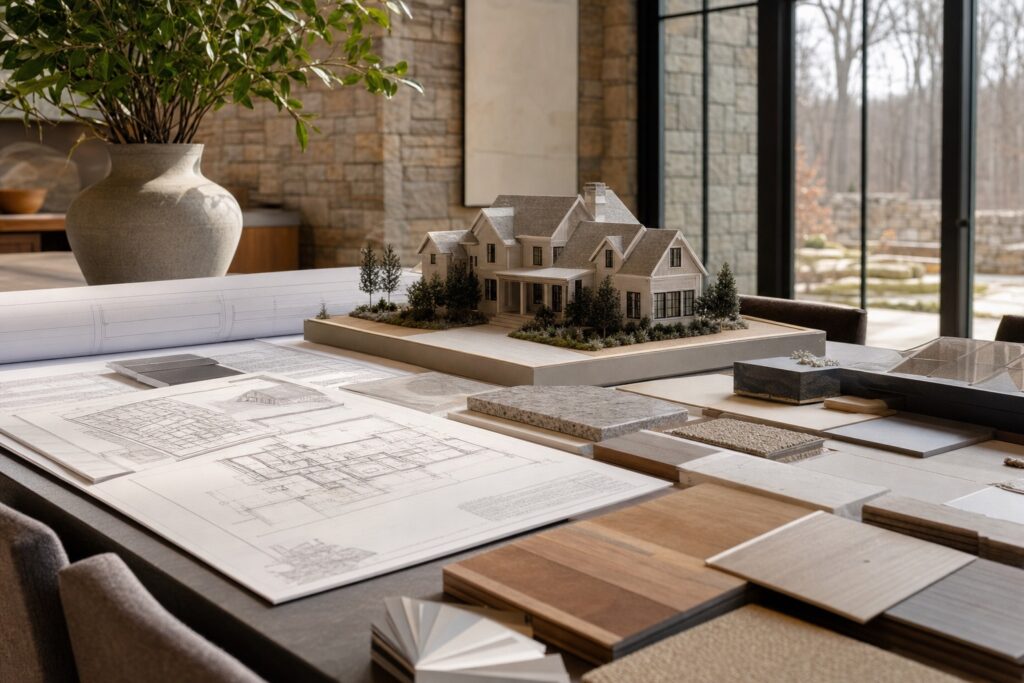
The short answer: design-build means one contract and one accountable team that handles both the design and the construction of your Northern Virginia project, while the general contractor (GC) model splits those responsibilities between a separate architect and builder that you, the homeowner, must coordinate. For most custom homes and major remodels across Fairfax, Loudoun, Prince William, and Arlington counties, design-build vs general contractor comes down to a tradeoff between integrated accountability and fewer surprises on one side, and maximum design independence with more owner involvement on the other. This guide breaks down how the two delivery methods compare on cost, change orders, timelines, accountability, and risk so you can choose the right structure before you spend a dollar on plans.
Table of Contents
Quick answer: design-build vs general contractor
In the design-build vs general contractor decision, design-build gives you one company responsible for design and construction under a single contract, which reduces change orders, prevents the design-versus-budget blame game, and produces a more predictable timeline. The traditional general contractor model uses a separate architect and builder, gives you more design independence and competitive bids, but puts coordination, risk, and any gaps between the drawings and the budget squarely on your shoulders. Neither is universally better; the right answer depends on your project size, your appetite for involvement, and how much budget certainty you need from day one.
| Factor | Design-Build | General Contractor (Design-Bid-Build) |
|---|---|---|
| Contracts | One contract, one team | Two or more (architect + builder) |
| Single point of accountability | Yes | No — owner coordinates |
| Budget set with construction input | From day one | After design is finished |
| Change-order frequency | Lower | Higher |
| Design independence | Moderate | High |
| Competitive bidding | Limited | Strong |
| Typical timeline | Faster, overlapping phases | Longer, sequential phases |
| Risk of design/budget gap | Low | High |
| Owner time commitment | Lower | Higher |
| Best for | Custom homes, major remodels, budget certainty | Highly bespoke architecture, owner wants full control |
What design-build vs general contractor actually means
Before you can choose between them, you need a precise picture of how each delivery model is structured. The terms get used loosely in Northern Virginia, and a lot of homeowners discover too late that the “design-build firm” they hired was really a builder who subcontracts design, or that their “architect” expected them to find and manage their own contractor. Understanding the real mechanics of each model — who holds the contracts, who carries the risk, and where the money flows — is the foundation of every other comparison in this guide. The distinction matters most on larger projects in places like McLean, Great Falls, and Vienna, where six- and seven-figure budgets leave little room for confusion about who is responsible for what.
The design-build model
In design-build, a single firm signs one contract with you and takes responsibility for both designing and constructing your project. The architect or designer, the project manager, the estimators, and the construction crew all work for the same company or under the same coordinated umbrella. That means the people drawing your addition in Oakton are sitting in the same meetings as the people who will actually frame, wire, and finish it. Because construction expertise is present from the first sketch, the design is shaped by what is buildable and affordable in your specific market, not just what looks good on paper. You communicate with one team, sign one agreement, and hold one entity accountable for the outcome from concept through final walkthrough.
The general contractor (design-bid-build) model
The traditional model — often called design-bid-build — separates design from construction into distinct contracts and distinct companies. First you hire an architect or designer to produce a complete set of drawings. Then you take those drawings out to bid, collect proposals from general contractors, and hire one to build what was designed. The architect and the builder have no contractual relationship with each other; both answer to you. This structure gives you a finished, independent design before you commit to a builder, and it lets you compare competitive bids on identical plans. The tradeoff is that you become the hub connecting two parties whose incentives, schedules, and interpretations of the drawings do not always align.
Hybrid arrangements you will encounter
Most real projects fall somewhere on a spectrum. Some architects offer light construction administration; some general contractors have in-house designers and market themselves as design-build even when design is a thin layer. You will also see “architect-led design-build” and “contractor-led design-build,” which differ in who drives the process. When you interview firms across Arlington, Alexandria, or Loudoun County, ask exactly who employs the designer, who carries the construction risk, and whether estimating happens during design or only after. The labels matter less than the actual contract structure and the point at which real construction pricing enters the conversation.
Accountability: who owns the outcome
Accountability is the single biggest practical difference in the design-build vs general contractor debate, and it is the factor homeowners underestimate most. When something goes wrong — a window that doesn’t fit the rough opening, a beam that wasn’t specified, a finish that costs triple the allowance — the question is always the same: whose problem is it? In one model the answer is clear and the fix moves forward immediately. In the other, you may spend weeks refereeing a dispute between two companies who each insist the other is at fault. On a major Northern Virginia renovation, that gap can mean tens of thousands of dollars and months of delay.
Single point of responsibility in design-build
With design-build, there is no one to point a finger at because the same firm owns both the drawing and the execution. If a detail is missing or a dimension is wrong, the company that designed it is the company that has to build it, so it gets resolved internally and absorbed by the team rather than billed to you as a change order. This alignment removes the structural incentive to blame the other party. For homeowners in Great Falls or Vienna managing demanding custom builds, that single throat to choke is often worth more than any line-item savings, because it converts a potential dispute into a routine internal coordination problem.
The blame game in the GC model
In design-bid-build, the architect and the contractor are independent, and their interests can diverge the moment a problem appears. The contractor says the drawings were incomplete; the architect says the contractor built it wrong. Both are partly right, and you are caught in the middle, often paying for the resolution regardless of fault. This adversarial gap is structural, not a sign of bad people. It exists because two companies are protecting their own margins and reputations. Resolving it consumes your time, your money, and your goodwill, and it tends to surface at the worst moments — mid-framing, mid-schedule, and mid-budget.
Warranty and post-completion service
After the project ends, accountability still matters. A design-build firm that stands behind both design and construction gives you one place to call when something needs attention in year one or year two. In the split model, a warranty claim can again become a question of whether the issue stems from a design flaw or a construction defect — and which party is responsible. Clarifying warranty terms up front, in either model, protects you long after the final invoice in Bristow, Gainesville, or Ashburn.
Cost implications of each model
People assume the cheaper-sounding path is design-bid-build because it invites competitive bidding, and on the surface that is true. But the real cost of a delivery model isn’t just the contract price — it’s the total you pay after change orders, redesigns, and value-engineering. In the design-build vs general contractor comparison, design-build often wins on total cost certainty even when its initial number isn’t the lowest, because pricing is grounded in construction reality from the start. Below is how the money actually behaves under each structure on Northern Virginia projects, where labor and material costs run well above national averages.
Competitive bidding versus integrated pricing
The GC model’s signature advantage is the competitive bid: identical plans go to several builders, and you choose among real numbers. That pressure can lower the construction price. Design-build does not give you three bids on the same drawings, so you trade competitive tension for integrated pricing — a budget developed alongside the design by the people who will build it. The question is whether a lower bid on paper survives contact with reality, or whether it balloons through change orders once construction exposes what the drawings missed.
The hidden cost of value engineering
Here is the trap in design-bid-build: you fall in love with a design before anyone has priced it. The bids come back far over budget, and now you pay an architect to redesign while the builder waits — or you accept painful value-engineering cuts to a plan that was never realistic for your budget. That rework costs money and morale. Design-build avoids it by pricing as it designs, so the plan you approve is one you can actually afford. On a $400,000 Loudoun County addition, avoiding a single redesign cycle can save both weeks and many thousands of dollars.
Change orders and budget creep
Change orders are where budgets quietly explode. Every gap between the drawings and the build is a potential change order, and in the split model those gaps are common because the designer and builder never coordinated. Design-build compresses that gap, so there are fewer surprises and fewer mid-project price increases. Fewer change orders also means fewer schedule disruptions, which themselves carry cost in a high-rate Northern Virginia construction market.
| Cost element | Design-Build | General Contractor |
|---|---|---|
| Initial design fee | Bundled with construction | Separate architect fee (often 8%–15% of construction) |
| Competitive bid savings | Limited | Potentially significant |
| Value-engineering rework | Rare | Common when bids exceed budget |
| Change-order frequency | Lower | Higher |
| Budget certainty at design approval | High | Low until bids return |
| Total-cost predictability | Strong | Variable |
Timeline differences
Time is money on any Northern Virginia build, and the two models handle scheduling very differently. Design-bid-build is sequential by nature: design fully, then bid, then build. Design-build overlaps those phases, which usually delivers a faster path from first meeting to move-in. But speed is not the only consideration — the predictability of the schedule matters as much as its length, especially when you are carrying a construction loan or coordinating a temporary move out of your Fairfax or McLean home.
Sequential versus overlapping phases
In design-bid-build, each phase must finish before the next begins. The architect completes drawings, then bidding takes weeks, then the chosen contractor mobilizes. Design-build lets construction planning, permitting prep, and long-lead ordering begin while design is still being refined, collapsing dead time between phases. That overlap is the primary reason design-build projects often reach completion sooner than equivalent design-bid-build projects.
Permitting and inspections in Northern Virginia
Every county here has its own permitting rhythm. Fairfax County, Loudoun County, Prince William County, and Arlington each run distinct review processes, and Great Falls and McLean projects often involve additional considerations like septic, well, or resource-protection-area review. A design-build team that permits in these jurisdictions weekly can anticipate requirements and prepare submissions in parallel with design, reducing the back-and-forth that stalls split-model projects when the builder discovers the drawings don’t satisfy a local reviewer.
How coordination affects the schedule
In the split model, you coordinate the handoff between architect and builder, and any miscommunication adds days or weeks. Design-build internalizes that coordination, so the schedule isn’t hostage to two companies aligning their calendars. The result is fewer stalls and a timeline that holds closer to its original promise.
Pros and cons of each model
No delivery method is perfect. The honest way to choose is to weigh the real advantages and disadvantages of each against your specific project and temperament. Here is the candid breakdown homeowners across Arlington, Alexandria, and the Virginia Piedmont should weigh before signing anything.
Design-build pros and cons
Design-build’s strengths are integrated accountability, realistic budgets set early, fewer change orders, faster timelines, and a single relationship to manage. Its weaknesses are reduced competitive bidding, the need to trust one firm with both design and price, and somewhat less design independence — the same firm that designs is the one that profits from building it, so you should choose a firm whose design integrity you trust. The model rewards homeowners who value certainty and a streamlined process over squeezing the lowest possible construction bid.
General contractor pros and cons
The GC model’s strengths are strong competitive bidding, full design independence with an architect working solely for you, and clear separation between the design vision and the construction price. Its weaknesses are the coordination burden on you, the structural blame gap when problems arise, the risk of bids exceeding budget after the design is locked, and a longer sequential timeline. It suits owners who want maximum control, have a highly bespoke architectural vision, and are willing to actively manage two relationships.
Matching the model to your risk tolerance
If budget certainty and a single accountable partner matter most, design-build aligns with your risk tolerance. If you want an independent design advocate and competitive pricing — and you have the time and stomach to manage the process — the GC model fits. Be honest about how much involvement you actually want, because the wrong match creates friction no contract can fix.
When each model fits best
The right choice is project-specific. Below are the scenarios where each delivery method tends to outperform, drawn from how Northern Virginia projects actually unfold across the region’s varied housing stock.
When design-build wins
Design-build is usually the stronger choice for custom homes, whole-home renovations, large additions, and any project where budget certainty and timeline matter. It shines when you want one team to own the result, when the project is complex enough that design-construction coordination is constant, and when you’d rather spend your time on decisions than on refereeing two companies. Most major remodels in Vienna, Oakton, and Fairfax fit this profile.
When a general contractor fits
The GC model fits when you have a strong, specific architectural vision and want an independent architect who answers only to you, when you value competitive bidding above process simplicity, or when you already have completed drawings and simply need them built. Owners pursuing distinctive custom architecture in McLean or Great Falls sometimes prefer this independence, accepting the added coordination as the price of design purity.
Project size and complexity
Smaller, well-defined projects can succeed under either model. As scope and complexity grow — multi-room renovations, structural changes, additions that touch mechanical and exterior systems — the coordination advantages of design-build compound, and the split-model’s blame gap becomes more expensive. The bigger and more interconnected the project, the more design-build’s integration pays off.
Design-build vs general contractor by Northern Virginia area
Delivery-model decisions play out differently across the region because housing stock, lot conditions, and permitting all vary by county and community. Here is how the design-build vs general contractor choice tends to land in each major Northern Virginia market.
McLean and Great Falls
McLean and Great Falls projects skew large and complex — estate renovations, substantial additions, and high-end custom homes on acreage. Great Falls lots frequently involve wells, septic systems, and resource-protection-area constraints that demand tight design-construction coordination. Design-build’s integration is especially valuable here, where a missed site condition can derail a split-model schedule, though some owners chasing singular architecture still opt for an independent architect.
Vienna, Oakton, and Fairfax
This corridor is dense with mid-century and older homes ripe for whole-home renovation and additions. Projects often involve reworking dated layouts, which benefits from construction input during design. Design-build tends to win here because realistic budgeting and fewer change orders matter on renovations where existing conditions are full of surprises behind the walls.
Arlington and Alexandria
Arlington and Alexandria projects contend with smaller urban lots, tighter setbacks, historic-district review in parts of Alexandria, and challenging logistics. Coordination is at a premium, and the single-team efficiency of design-build helps navigate constrained sites and stricter review. The GC model remains viable for owners with a clear vision who want independent design advocacy through the review process.
Loudoun County
Loudoun County — Ashburn, Leesburg, and the surrounding area — mixes newer subdivisions with rural Piedmont properties. Additions, finished lower levels, and custom builds are common. Design-build’s predictable budgeting suits Ashburn homeowners watching costs, while larger rural Leesburg builds benefit from integrated permitting and site coordination.
Prince William County
In Prince William County — Gainesville, Haymarket, and Bristow — homeowners frequently pursue value-focused renovations and additions where budget certainty is paramount. Design-build’s early, construction-grounded pricing protects against the bid-over-budget surprise that derails split-model projects, making it a natural fit for cost-conscious projects across this growing market.
How to decide between the two models
With the tradeoffs clear, the decision comes down to a handful of honest questions about your project and yourself. Work through these before you interview a single firm.
Questions to ask yourself
How much budget certainty do you need before construction starts? How much of your own time can you give to coordinating professionals? Do you have a fixed architectural vision, or do you want expert guidance shaping it? How complex is the project, and how many systems does it touch? Your answers point clearly toward one model. Certainty, limited time, and complexity favor design-build; independence, available time, and a locked vision favor the GC route.
Questions to ask any firm
Whether you lean design-build or GC, interview rigorously. Ask who employs the designer, when real construction pricing enters the process, how change orders are handled and priced, what the firm’s permitting experience is in your specific county, and how warranty and post-completion service work. The answers reveal whether a self-described design-build firm truly integrates design and construction or merely bolts them together.
Red flags to watch for
Be wary of any firm that won’t talk budget until design is complete, that can’t explain its change-order process clearly, or that lacks local permitting experience in Fairfax, Loudoun, Prince William, or Arlington. In the GC model, watch for an architect who won’t engage with construction cost realities, and a builder whose bid seems too low — a number that climbs through change orders is no bargain.
How Valor Builder approaches your design-build vs general contractor decision
At Valor Builder, we operate as an integrated design-build firm so you get one accountable team and one realistic budget from the first conversation. Our design-build vs general contractor services bring construction expertise into the design process from day one, which is how we keep change orders low and timelines honest across Northern Virginia. We build throughout Fairfax County, Loudoun County, and Arlington, as well as Prince William County and the Virginia Piedmont, and we know each jurisdiction’s permitting and site realities firsthand. If you want the independence of the traditional architect-plus-builder route, we’ll tell you honestly when that fits your project better — because the goal is the right home, built right, not just a signed contract.
Frequently asked questions
What is the main difference between design-build and a general contractor?
Design-build is a single firm holding one contract for both design and construction, so one team is accountable for the whole project. The general contractor model separates design and construction into two contracts — a separate architect and builder — that you coordinate. The core difference is integrated accountability versus split responsibility.
Is design-build more expensive than hiring a general contractor?
Not necessarily. Design-build may not produce the lowest initial bid because it lacks competitive bidding, but it usually delivers better total-cost certainty by pricing during design and reducing change orders and costly value-engineering. The GC model can win on bid price yet end up costing more after redesigns and budget creep.
Which model has fewer change orders?
Design-build typically has fewer change orders because the same team designs and builds, closing the gaps between drawings and construction that drive change orders in the split model. Fewer change orders also mean fewer schedule disruptions and a more predictable final cost.
Is design-build faster than design-bid-build?
Usually, yes. Design-build overlaps design, permitting prep, and construction planning, while design-bid-build runs those phases sequentially with a bidding period in between. The overlap commonly shortens the overall timeline and makes the schedule more predictable.
Do I lose design control with design-build?
You retain control over design decisions, but the designer works within the same firm that will build the project, so the design is shaped by buildability and budget from the start. If you want a fully independent design advocate, the GC model offers more design independence. Choose a design-build firm whose design quality you trust.
Who is responsible if something goes wrong in design-build?
The design-build firm is responsible, since it owns both the design and the construction. There is no blame game between separate parties, so issues get resolved internally rather than billed to you or disputed between an architect and a builder.
When does hiring a general contractor make more sense?
The GC model makes sense when you have a strong, specific architectural vision, want an independent architect working solely for you, value competitive bidding, or already have completed drawings to build. It suits owners with the time and willingness to coordinate two relationships.
Does design-build work for remodels or only new homes?
Design-build works well for both. It is especially valuable on remodels and additions in Northern Virginia, where existing conditions hidden behind walls create surprises that benefit from construction input during design. Whole-home renovations in areas like Vienna and Fairfax are a common fit.
How does competitive bidding work in design-build?
Design-build does not put identical plans out to multiple builders, so you trade competitive bidding for integrated pricing developed alongside the design. You can still validate pricing by comparing firms during selection and by reviewing transparent allowances and subcontractor pricing within the contract.
What is value engineering, and why does it matter?
Value engineering is cutting or substituting elements of a design to reduce cost, often after bids come back over budget. In the GC model it is common and disruptive because pricing happens after design is complete. Design-build largely avoids it by pricing as it designs, so the approved plan is already affordable.
Which model is better for Northern Virginia permitting?
Design-build often handles permitting more smoothly because one team manages submissions and anticipates each county’s requirements, preparing them in parallel with design. Fairfax, Loudoun, Prince William, and Arlington each have distinct processes, and integrated coordination reduces the back-and-forth that stalls split-model projects.
How do I know if a firm is truly design-build?
Ask who employs the designer, whether estimating happens during design or only after, and who carries the construction risk. A true design-build firm integrates design and construction under one accountable team, not just a builder who subcontracts design as a thin add-on.
Can I switch from a GC approach to design-build mid-project?
It is possible but disruptive. If you already have an architect’s drawings, a design-build firm can take over construction and provide integrated delivery from that point. The cleanest results come from choosing your model before design begins, so pricing and buildability inform the plan from the start.
Which model is best for a tight budget?
For a tight budget where certainty matters most, design-build is usually safer because it sets a realistic, construction-grounded budget early and minimizes the change orders and redesigns that blow up costs. This is why budget-conscious homeowners in Prince William County and Loudoun County often prefer it.
Plan your design-build vs general contractor with confidence
Choosing the right delivery model is the most important decision you’ll make before construction begins, and the team you bring on should help you make it honestly. Schedule a consultation with Valor Builder and we’ll walk through your project, your budget, and your timeline to determine whether integrated design-build or a traditional general contractor approach is the right fit for your Northern Virginia home.